


All right, so I know we said in our last installment of The Data Junction that next time we’d be talking about the long-distance replacement fleet. We’ll have to hold off on that for another time, because some of the new information Amtrak shared at RailNation on October 3 gave us an excuse to take a closer look at some interesting possibilities as the fleet expands. You can watch their presentation here. In the meantime, it’s worth contemplating how we think about new routes, because ultimately the fleet Amtrak will procure in the next few years will have to serve the network of the future, not just the network we have today. As it turns out, that’s not a new idea at all, but one which goes back to the earliest days of Amtrak.
When discussing the future of intercity rail in North America, one of the common questions advocates face from a skeptical public is whether a suggested train route is viable. Often it sounds more like ‘well who would ride this thing anyways?’ but what people are really asking is, ‘does investing in this make sense relative to the alternatives?’ The days when passenger rail was the only travel option have long passed, and while in other nations the passenger train has reestablished itself as a competitive transportation mode, this is not so in the United States. Despite being practically built around railroads, Americans have lost the regular experience of train travel in daily life. Hence, the question of whether people would ‘really ride this thing?’ always needs answering.
Luckily, this was addressed by the USDOT way back when they were putting together Railpax, later Amtrak, in 1970. Secretary of Transportation John Volpe provided a report for the ever-skeptical President Nixon outlining a basic network split between two types of trains: long-distance overnight trains, once-per-day, connecting key regional endpoints and short-distance trains, twice per day, serving intercity corridors.
It’s the latter which bears further discussion today.
Volpe and his department explained on the second page of their memorandum that “The corridor designation applies to a pair of cities each with a population of one million or more and less than 300 miles apart.”1 There were other filters as well:
Corridor routes were selected if the demand projected for 1975 was sufficient to permit trains to compete effectively with buses on a time basis and airplanes on a cost basis. The demand was forecast by either (1) projecting existing demand or (2) using a demand model developed in the Northeast Corridor Study2 for cases where existing demand has been artificially depressed by poor rail service.
Using the above, the USDOT identified the following city pairs that fit the criteria and had existing corridor service.
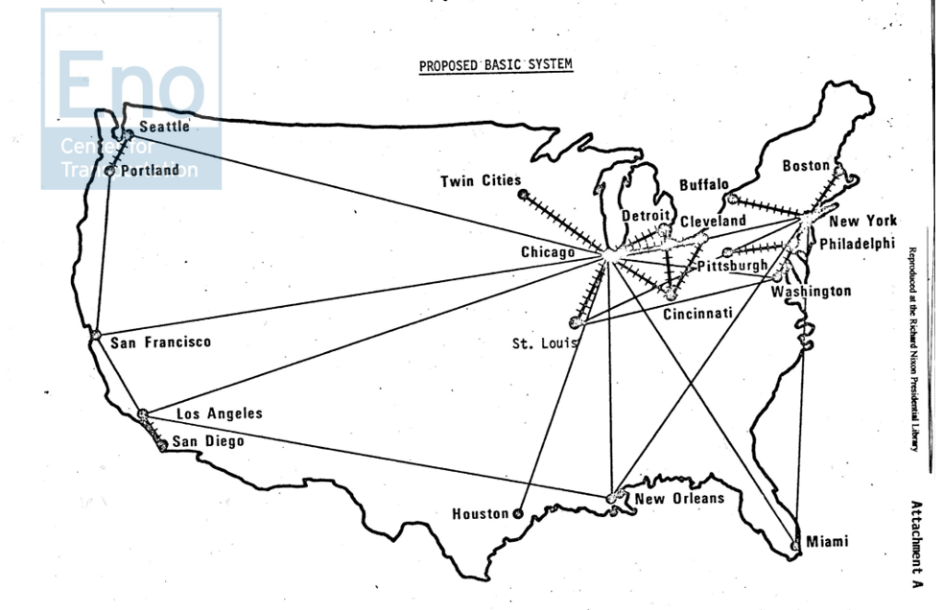
When the public got ahold of the proposed basic system, they were appalled. Out of the hundreds of trains still operating, only 27 routes were to be saved, of which 14 were to be long-distance overnight trains. A more substantial network was eventually salvaged in the face of public pressure heading into the 1972 elections, resulting in a mostly recognizable version of the Amtrak we all know today.
What we must note is the USDOT’s criteria for viable corridors:
City pairs of around 1 million people each within 300 miles
Time competitive with a bus
Cost competitive with an airline
There were more city pairs fulfilling these criteria in 1970 than were chosen for the basic system, since the USDOT excluded routes which had no remaining corridor trains. At the time there were 57 possible pairings, with 25 selected for service and a further 7 accessible with a single transfer.3
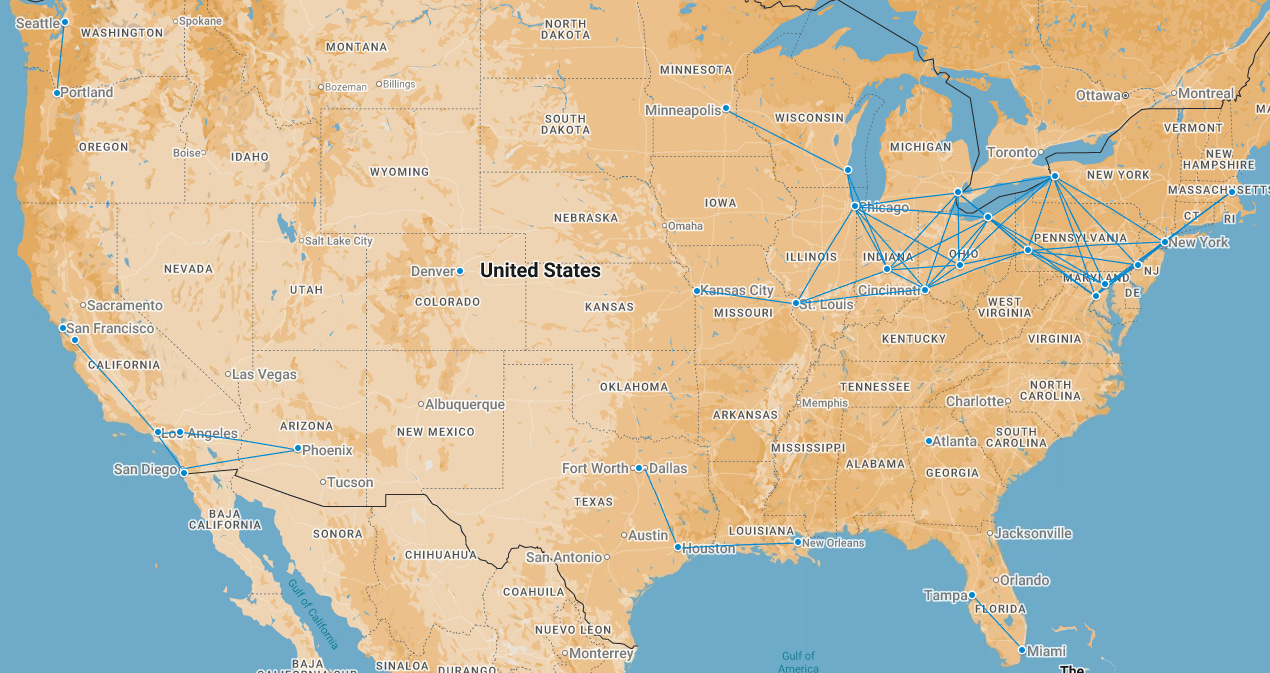
If there were 57 viable corridors in 1970, how many are there today? By analyzing the 2020 US Census Metropolitan Statistical Areas (MSA’s) and their Canadian equivalents, we can reconstruct a modern version of Volpe’s map.
For the sake of accuracy, the following corridors were excluded:
Short-haul commuter service
Routes crossing physical barriers
Routes lacking a direct rail connection
Routes entirely within Canada
There are 198 city pairs that qualify today.
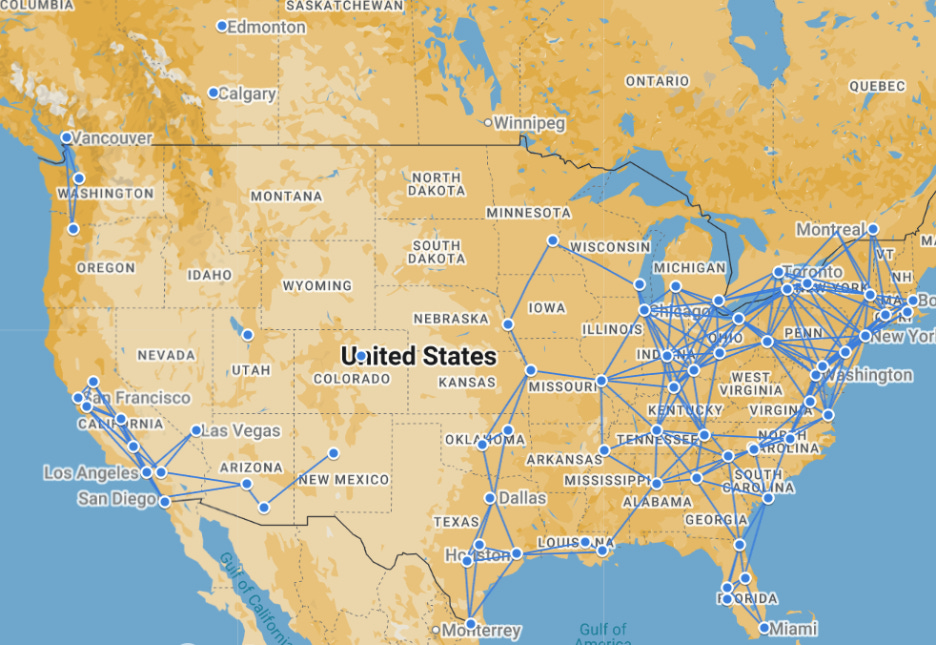
Quite a few pairs have existing rail service, with nine overlapping to form the Northeast Corridor. A further forty-six pairs have 2+ trains per day, including long-distance service. Nine cities have convenient single transfers that effectively connect them, such as Albany – Philadelphia. This leaves thirty-two pairs with inadequate service, fewer than two trains per day and often at odd hours of the night. A staggering 101 city pairs have no service at all!
A map of population density with these pairs overlaid reveals a critical lack of routes where millions more people live today than in 1970. Many cities with no service, such as Nashville and Cincinnati, should be thriving hubs of activity at the crossroads where many routes come together.
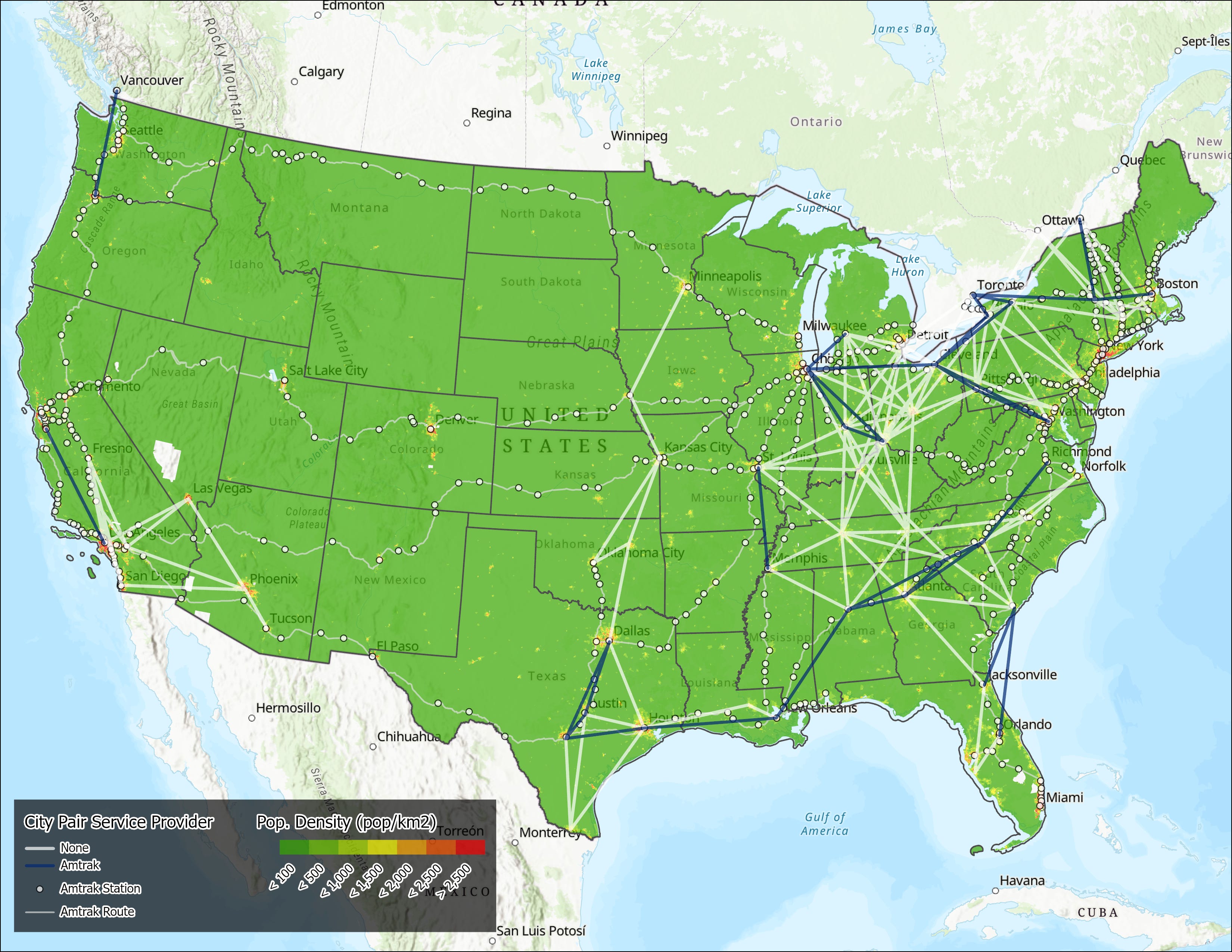
This visualizes something that rail advocates hear all the time: “I’d love to take the train, but it doesn’t go where I need to, when I need it.” We agree! Decades of underinvestment in our passenger rail system have left vast swathes of the country behind, especially MSAs, which have grown dramatically since 1970.
One can easily trace a future ‘Southeast Corridor’ over the S-Line from Washington and Richmond to Raleigh, Greensboro, Charlotte, Greenville, and Atlanta. Others belong to trains long discontinued, such as the original Floridian, or pre-Amtrak trains such as the ghost of the Cincinnatian from Detroit to Cincinnati or the Buffalo Day Express from Buffalo to Washington, D.C. via Harrisburg.
Not all corridors are created equal. Buffalo to Washington, D.C. covers 191 miles as the crow flies, but the two endpoints together only have 7,621,377 people in their MSA’s connected by winding freight tracks through rural Pennsylvania. By contrast, Houston – Austin has 10,525,572 within 145 miles along a mostly straight route. This analysis was not meant to determine which pairs were the most realistic, a question for another day.
This brings us to the largest unaddressed question: Which of these routes are time competitive with an intercity bus? In 1970, with uncongested highways, the answer was ‘not many’. Today, America is choked with traffic and getting worse by the year.
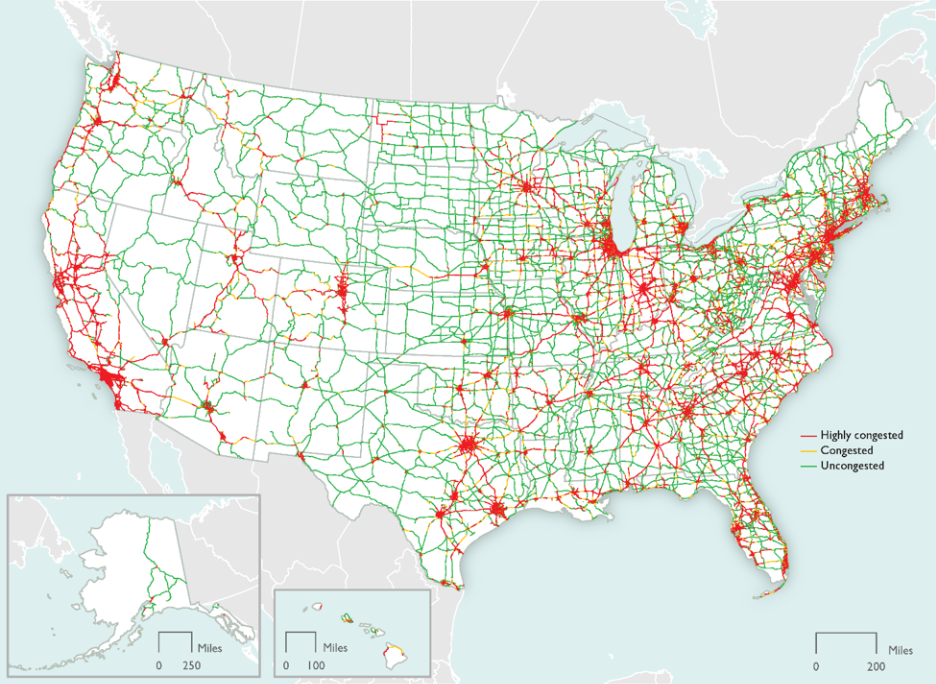
Very soon, the most direct highway routes for intercity buses between most cities in America will be so congested that even with current track conditions, a passenger train would be time competitive with them. As plane tickets grow more expensive, short-haul flight schedules grow more sparse, and as more buses and cars sit in traffic for hours, the need for a realistic alternative will only grow.
Only our rail system has the capacity to keep America moving.
There is a certain irony in the fact that the same USDOT that was actively planning and building the interstate highways as a comprehensive national network in the 1970’s did not do so for Amtrak. In the eyes of the USDOT, highways were being built for the future and passenger rail was a salvage job stuck in the past. The consequences of that distinction have never been clearer.
The Corridor ID program and the FRA Long Distance Study are signs, very encouraging ones worth celebrating, that the USDOT is beginning to recognize the scale of the challenge facing us. These are the first tentative steps toward building the rail system we need. Yet even if every route being studied today were fully implemented, it wouldn’t bring two trains per day to every city pair analyzed in this post.
We need to start thinking bigger.
This is why the question of viability is frustrating, because while trains from Tulsa – Oklahoma City or Buffalo – Pittsburgh would perform well, there are no plans to implement such services. Occasionally one of these corridors gets brought up by well-meaning local officials, only for them to be flooded with questions about viability. When we built the interstate system, nobody demanded that we separately study every new mile of pavement. Why do we need to do so for trains?
America deserves a proper rail network, useful and available to every American nationwide, not just on a handful of legacy routes. We’ll only get there if we break free of the mindset that investments in other modes of transit are common goods, but America’s national railroad must prove itself over and over, just as it did fifty years ago. The demand existed then, and it certainly exists today; the question is whether our nation will invest properly and build for the future. The alternative is to be stuck in traffic for another half century.
The distance and population criteria for three corridors where existing demand was strongest were relaxed, an early indication that the population and distance criteria were too strict even in 1970
Note that what we know today as the Northeast Corridor did not exist in 1970 and was instead still just a ‘Study’ by the USDOT. Creating the modern corridor and reorganizing freight rail in the region via Conrail was a multi-decade undertaking which required long-term planning and vision, a lesson which should be taken to heart today. For further reading about the NEC’s creation, we recommend this excellent post by Uday Schulz.
Sourced from the 1970 US Census. The USDOT map from 1970 looks remarkably sparse now, but at the time it would have provided decent coverage to a very large portion of the urbanized population. When including commuter trains not transferred to Amtrak or the long-distance routes, every single MSA would have retained at least one train per day. This is not the case today.
So regarding the Amtrak led Corridor ID routes, why exactly is it that the two overnight routes, Sunset Limited and Cardinal have not moved from Step 1 to 2, but the highly served and overlapping Amtrak to Long Island through route has moved into Step 2? Amtrak spent only $35k of their $500k grant for the first two routes then gave the rest back. Are they truly still studying the overnight routes or did the presenters just not get the correct memo?
One small omission re: air travel: the time spent getting to and from airports and getting through huge TSA lines inside the airports.
Remember when flying was fun? Not any more.
Which is why we have an even more effective message today.