


Well, laryngitis kept me from delivering the remarks I had prepared for this week’s Hospitality Forum at InnoTrans in Berlin, where I was supposed to talk about Europe’s renewed interest in night trains. As consolation prizes go, wandering around the Innotrans displays looking at actual trains isn’t all that bad...
One of the more interesting things I found was ALISA, a German research project exploring what a future European night train might look like. Its full-size bilevel mockup included some genuinely beautiful private cabins — the designers call the larger ones “apartments” — along with family spaces, compact two-person accommodations and, intriguingly, deeply reclining seats placed just outside some of the cabins. I think those seats may have been the most interesting part.
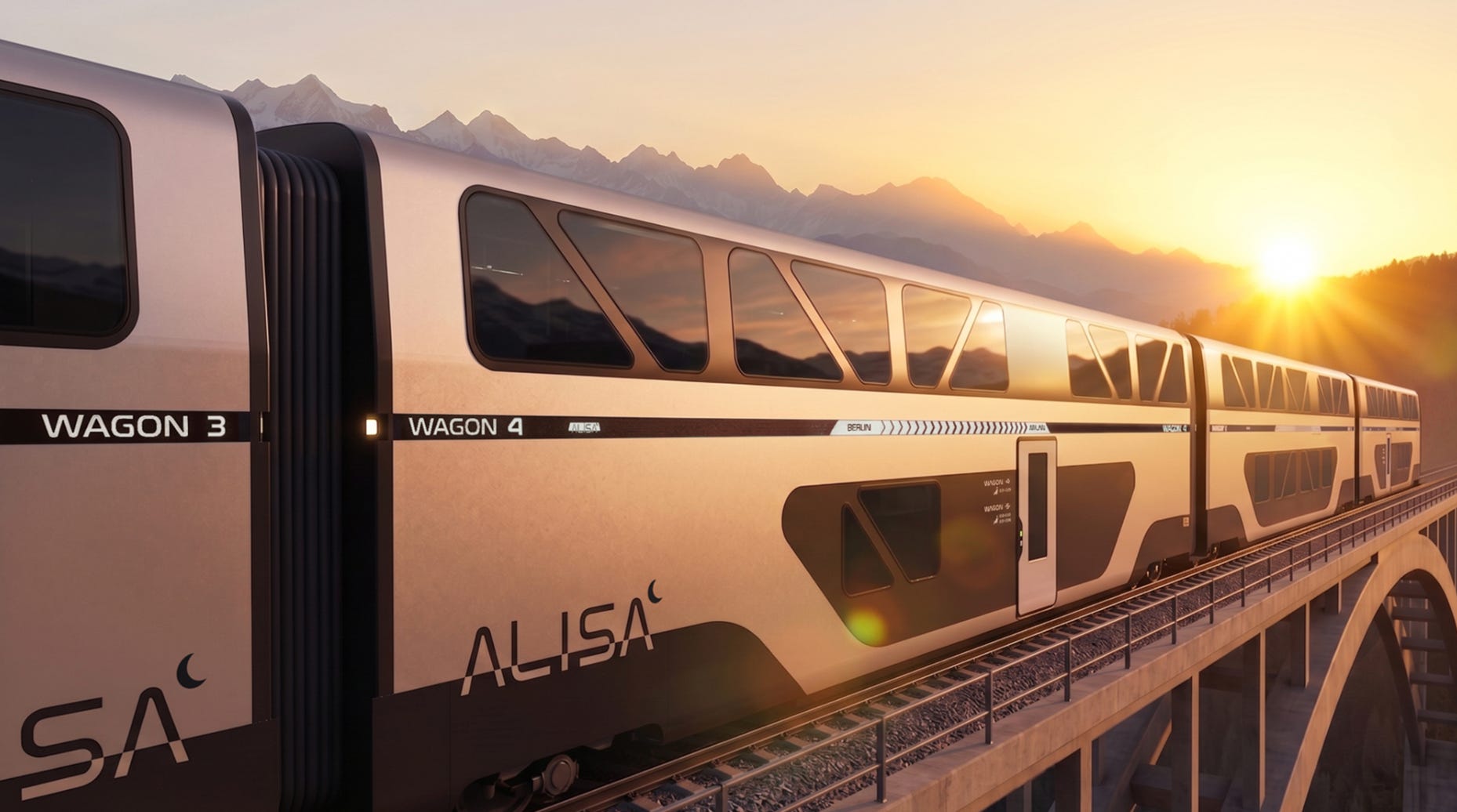
Image: German Aerospace Center
The idea is to create something for a passenger, perhaps a student or backpacker, who doesn’t want to spend the night bolt upright in an ordinary coach seat but also can’t afford or won’t pay for a private cabin. In other words, instead of assuming there are only two kinds of passengers, ALISA creates another rung on the ladder.
Video: Jim Mathews
That sounds obvious once you see it. Which, naturally, is usually when we Americans begin wondering why we haven’t been doing it already.
The larger idea behind ALISA isn’t really just designing a nicer sleeping car. Instead, it recognizes that different passengers are buying different products even when they happen to be riding the same train. In a single consist, you have conventional seats, reclining overnight seats, private cabins, larger rooms, and family accommodations. And all kinds of spaces that can work differently by day and by night.
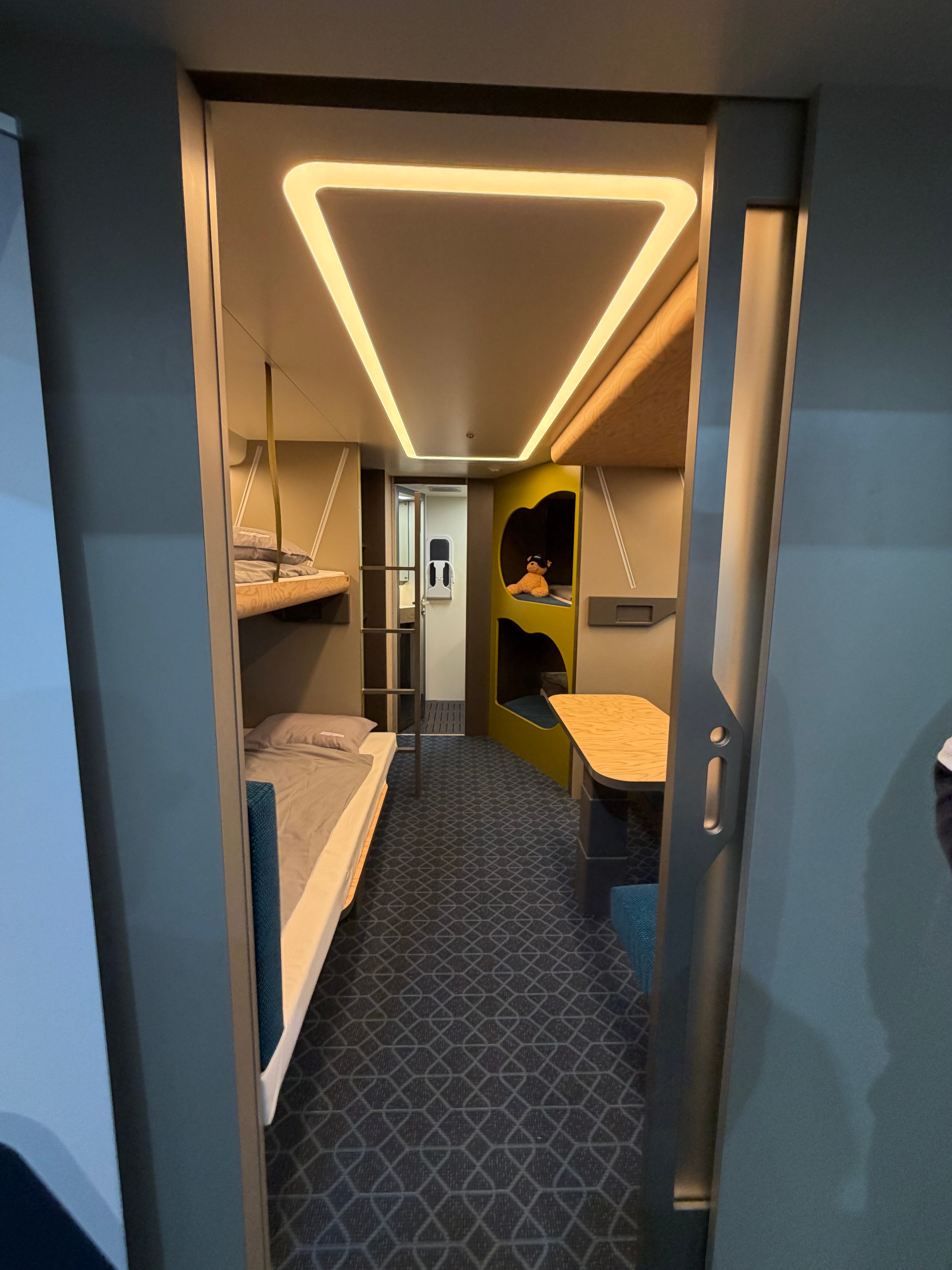
Image: Jim Mathews
It’s a hospitality mindset, and it’s much closer to the way hotels and cruise ships think about customers than the way railroads traditionally do, especially in the modern U.S. era in which passengers aren’t much more than freight that can complain.
There was also a useful accessibility lesson built into the mockup. Wheelchair accommodations were on the lower level, while the bistro was upstairs. I asked what happened when a passenger using a wheelchair wanted something from the bistro. The answer was that food could be brought downstairs.
Well, okay, but why not put the bistro downstairs? The presenter paused and said, essentially, yes, that was something they could consider.
That exchange is one reason full-size mockups really make a difference. CAD drawings are wonderfully accommodating. Actual human beings have a nasty habit of exposing the things the drawings forgot.
Amtrak folks on this Innotrans trip stopped and got a good look at this mockup, and seemed to walk away impressed. Still, this is probably good place for me to stop and throw out an important caution before Americans look at ALISA and simply say, “We should buy that.” European and American long-distance trains are often solving different problems.
Many European night trains are essentially one-night propositions. Board in the evening, perhaps have dinner, sleep, wake up in another city, have breakfast and get off. Berlin to Vienna, Berlin to Zürich and Hamburg to Vienna are variations on that basic idea. Berlin–Vienna is roughly an 11-hour overnight run; Berlin–Zürich is about 12 hours; Hamburg–Vienna about 14. You board in the evening, eat something, sleep, have breakfast, and get off. Berlin–Zürich, for example, is roughly 415 miles and the current Nightjet is scheduled for about 12 hours; Hamburg–Vienna is roughly 463 miles and about 13.5 hours overnight.
Our western long-distance trains can run for two nights and across three calendar days. Chicago to the Bay Area on the California Zephyr is more than 2,400 miles. Chicago to Los Angeles on the Southwest Chief is more than 2,200.
So, does that make the European comparison irrelevant? No, but it’s actually more interesting.
Amtrak’s own ridership patterns make the case for thinking this way. Look at a load profile for the California Zephyr and the supposed 2,400-mile market almost disappears. The relatively small band of passengers traveling all the way from Chicago to California stays aboard throughout, but around it the train is constantly changing. Chicago passengers get off. California-bound passengers get on. And throughout the journey, large numbers of passengers travel between two intermediate cities.
In other words, the California Zephyr isn’t one 52-hour journey. It’s a Chicago-to-Denver overnight train, a Denver-to-Rockies train, an intermountain service, a Reno-to-Bay Area train and dozens of other city pairs, all occupying the same equipment. It’s dozens, or really hundreds, of overlapping markets stitched together into a single train.
I think one thing that points to is that the American instinct toward standardization deserves another look. We see one train and tend to ask how few products we can put aboard it, to simplify and to take out cost. But the passenger data suggest we should be asking the opposite question: how many different journeys does this one train need to serve well?
Someone riding from Chicago to Denver is making a one-night journey that looks quite a bit like a European night-train trip. Another passenger might ride Denver to Salt Lake City. Someone else might use the Zephyr between Reno and Sacramento as an ordinary daytime intercity train. Meanwhile, another passenger is still aboard after two nights, having ridden nearly the entire route.
Amtrak’s own load analyses make this visually obvious. On the Zephyr, the relatively small number of passengers traveling from one endpoint all the way to the other is surrounded by much larger flows of people getting on and off at intermediate stations. The passenger population changes continuously as the train moves west. The same pattern appears on the Southwest Chief, Empire Builder and other long-distance routes.
Those passengers aren’t buying the same journey. The person spending two nights aboard has different needs from the person traveling overnight from Chicago to Denver. Both have different needs from somebody riding six hours during the day.
Yet the American instinct is usually to standardize and minimize. We want fewer car types, fewer floorplans, more common components. Simplified maintenance. Reduce the number of things that can break, reduce the number of things that need to be stocked, and please, whatever you do, don’t invent another specialty car.
There are good, practical reasons for all of that, and we don’t have the same ideas about passengers in general as, say, VIA Rail (which I think is a mistake...but you already knew that). But travelers are stubbornly non-standard. Efficiency doesn’t always come from “sameness.”
A college student willing to spend a little more for a near-flat seat is not the same customer as a retired couple occupying a bedroom for two nights. A family isn’t the same customer as a business traveler who needs workspace. Someone aboard for eight hours may value a very different product from someone who will still be staring at the same four walls tomorrow afternoon. In my view, serving all of those needs with a single trainset is arguably more efficient that offering them different trains, or travel modes, altogether.
Hotels figured that out long ago. Airlines did too. Nobody thinks it peculiar that an airline sells several different seating products on the same aircraft, or that a hotel offers everything from a basic room to a suite. Railroads, meanwhile, especially ours, have spent decades behaving as if “coach” and “sleeper” represented the full flowering of human preference.
ALISA asks a more interesting question: how many different markets can one train serve well? For America, the answer may be: even more than Europe.
That could mean conventional coach seats, deeply reclining overnight seats, compact private cabins, larger rooms and family accommodations. It also argues for public spaces — real lounges, dining areas, places to work and places simply to get out of your room. That last point is especially important on a two-night journey than on a train where everyone is getting off after breakfast.
So, I don’t think the lesson from ALISA is that America needs to copy a European night train. But I do think the lesson is that we should copy the thinking behind it. Start with the journeys passengers are actually making. Recognize that the people aboard the same train may be buying very different experiences. Then design the equipment, and the product ladder, around them.
Europe may be rediscovering the hotel train. America may need to rediscover something even more basic: a long-distance train isn’t one product at all. It is a platform capable of selling several different products to several different kinds of passengers, all at the same time. And perhaps that is worth remembering the next time somebody tells us that the cleverest thing we can possibly do is make everything exactly the same.