


I’m having a surprisingly complicated reaction to some very good passenger-rail news from Canada.
Yesterday, Prime Minister Mark Carney announced the largest investment in VIA Rail’s history: C$4.7 billion for 313 new Alstom passenger cars to replace the astonishingly elderly equipment still serving VIA’s long-distance, regional and remote routes.
And these aren’t generic coaches. Canada is buying nine different kinds of cars: coaches, sleepers, accessible sleepers, berth sleepers, Prestige sleepers, baggage cars, dining cars, panorama cars and — yes — 25 dome cars.
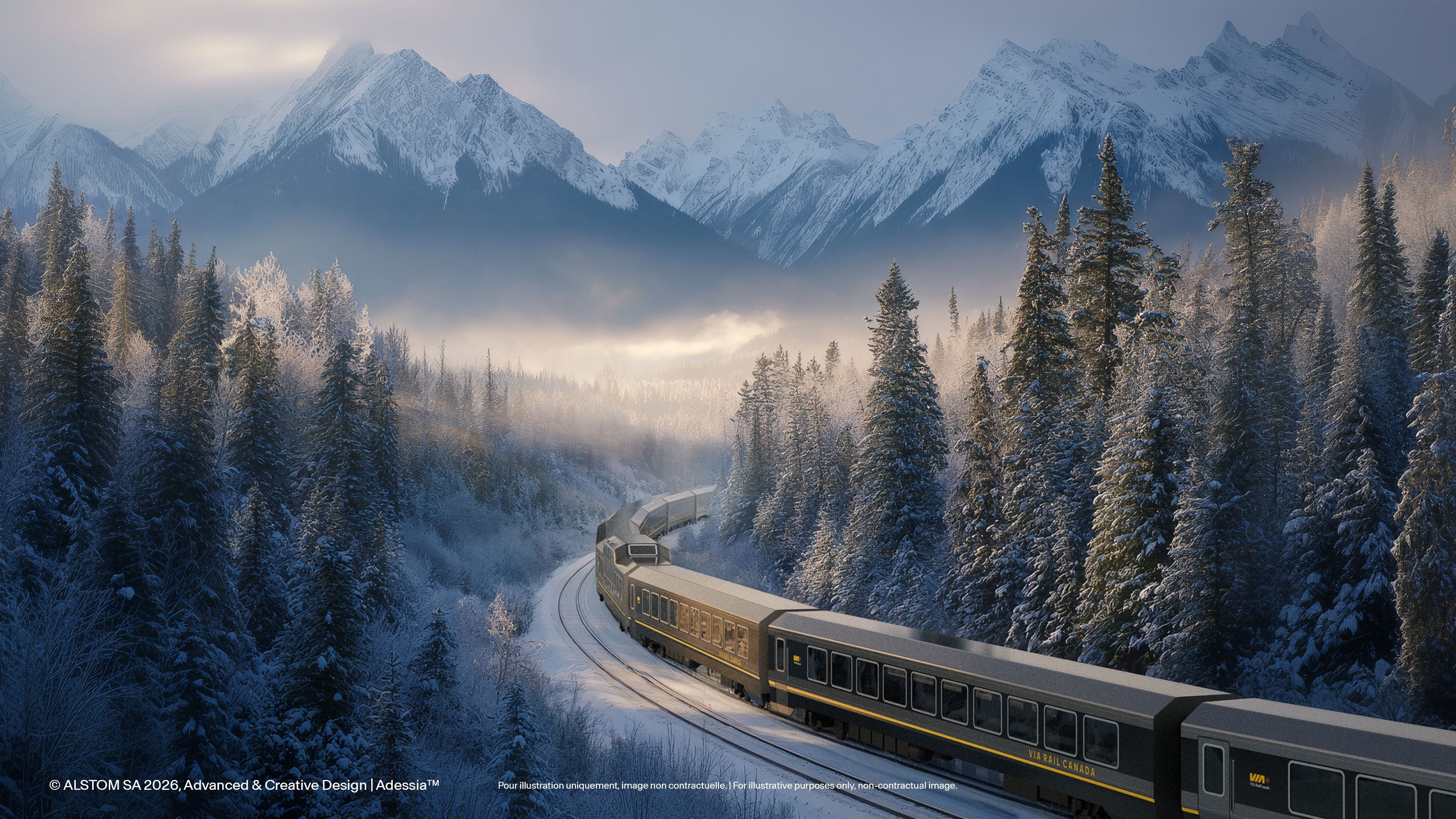
Image: Alstom (not a contractual image, just a concept)
The first are supposed to enter service in 2031, with the entire fleet in service by 2035.
That is wonderful news. Full stop. I know quite a few of those folks involved in this procurement, and I know they worked very hard to get here. My congratulations to all of them.
The VIA Rail order preserves something important about long-distance passenger rail that we have talked about a lot here: a train making a four-day journey across a continent isn’t just transportation. The equipment is part of the experience. VIA isn’t just replacing worn-out machinery. It is preserving full-service dining, social spaces, different sleeping accommodations, and the spectacular views that are part of the reason people ride The Canadian in the first place.
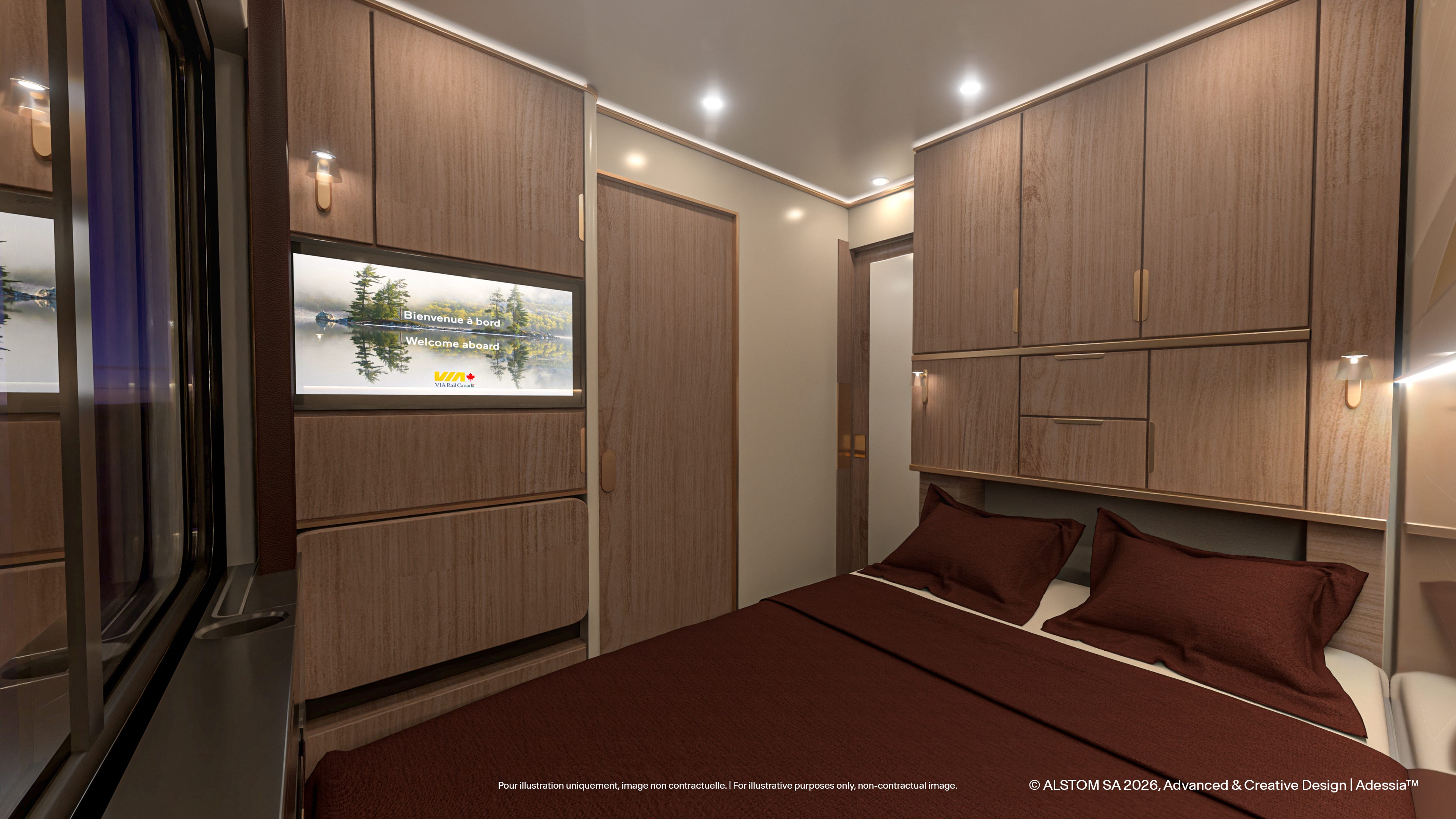
Image: Alstom (not a contractual image, just a concept)
This isn’t about some kind of luxury land-cruise, either. There’s a physical difference between riding a vehicle for a couple of hours and living in a space for two days or more.
And at the risk of sounding a little envious, there is something almost surreal about watching Canada buy, in concrete form, several of the things American passengers have repeatedly been told are too complicated, too specialized, or too difficult to procure. Nine car types. Dome cars. Full-service dining. First deliveries in 2031. Apparently, some of the laws of procurement work differently north of the border.
Amtrak’s original Superliner-replacement effort ran into trouble in part because manufacturers pushed back on complexity. Amtrak eventually changed course, moving to a universal single-level fleet and a new strategy built explicitly around standardization, broader competition and reduced program risk. There are sensible reasons for that decision, and I have defended it.
Still.
Nine car types. Dome cars. First delivery in 2031. Canada apparently didn’t get the memo.
There is another part of yesterday’s announcement that leaves me considerably less cheerful.
This is intentionally a Made-in-Canada procurement. Design and engineering will happen in Québec. Carbody manufacturing will happen in La Pocatière. Manufacturing and final assembly will happen in Thunder Bay. Carney went farther in his remarks, saying Canada is building the capacity to manufacture every component of these trains at home. Manufacture, not just assemble. The government says Alstom will draw on more than 900 Canadian suppliers and maximize the use of Canadian steel.
Given the increasingly ugly U.S.-Canada tariff fight, I understand exactly why Canada is doing it. Canadian taxpayers are paying for these cars, and Ottawa has made a deliberate policy choice to use that spending to build Canadian industrial capacity and reduce dependence on the United States. If I’m in their shoes, I absolutely do the exact same thing.
But this part hits especially close to home for me. I was at the ceremony last year when Alstom opened its new Plant 4 in Hornell, New York, about an hour and 20 minutes from my house. The mood that day was genuinely exciting: Hornell wasn’t just getting another factory expansion. Upstate New York was positioning itself to become a real hub of North American passenger-rail manufacturing, with the skills, tooling, and industrial base to build the next generation of trains for both sides of the border.
Alstom spent $75 million on that plant specifically to bring stainless-steel passenger-car shell production back to the United States. It’s one of only a few American facilities capable of doing that work, and it is far and away the most sophisticated…at least for now. In other words, we had the beginnings of exactly the kind of continental rail-manufacturing ecosystem that both countries ought to want.
That’s why the VIA announcement feels a little bittersweet. Canada has every right to respond to Washington’s tariff policy by protecting Canadian jobs and Canadian manufacturing. But one result is that an emerging cross-border rail-manufacturing ecosystem is suddenly being divided by an increasingly high economic fence. Hornell was supposed to be part of that North American story. Now we have to wonder how much of that opportunity survives.
That may well matter when Amtrak chooses the builder for its own 800-plus-car long-distance fleet, which it currently expects to do by the end of 2027. Amtrak can’t just buy Canadian-built VIA cars; U.S. domestic-content rules would prevent that. But an Alstom win on both sides of the border could still have created a genuine North American platform — common engineering, common systems and common intellectual property, with Canadian cars built in Canada and American cars built in places like Hornell.
Instead, trade barriers and retaliatory industrial policies are pushing the two countries toward increasingly separate supply chains. That may be rational politics in the short term. But I’m sure not convinced it’s rational industrial policy over the long term.
So, yes, congratulations to VIA Rail, to Alstom and particularly to Canadian passengers. These trains look terrific, and I am genuinely excited to ride them.
I’m also going to be watching very closely when Amtrak opens those bids. Because this is now one more very visible example (among so many!) of Canada getting something Americans have been assured is impractical: a varied, purpose-built long-distance fleet that treats the onboard experience as an essential part of the service rather than an inconvenience to be standardized away.
If Canada can have nine different kinds of long-distance cars, real dining cars, panorama cars and dome cars, arriving beginning in 2031, American passengers are entitled to ask a perfectly reasonable question: Why can’t we?
There is, of course, an answer to that very obvious question: money.
The Canadian order is breathtakingly expensive. Alstom values the 313 cars themselves at roughly C$4 billion, with another C$700 million for 15 years of technical support and spare parts. Spread across the fleet, the equipment portion alone works out to roughly US$9 million per car at current exchange rates. Include the support agreement and you are getting awfully close to US$11 million per car.
That’s sticker shock by almost any standard.
And it helps explain why Amtrak has spent so much effort trying to simplify its own procurement. Complexity costs money. Nine car types cost money. Dome cars cost money. Maintaining specialized equipment for decades costs money.
But there is, for sure, another way to look at it: Canada has apparently decided that preserving the character and capability of long-distance passenger rail, and creating a robust domestic car-builder industrial base that can afford to keep innovating, is worth paying for.
That is a policy choice, too.
Here I think Carney deserves the last word. Explaining just how ancient VIA’s present fleet is, Carney (an Oilers fan from way back) noted that the cars date from an era when the NHL had six teams, goalies didn’t wear masks — and “the Leafs would win the Cup.”
Ouch. Elbows up, indeed. Watch the full remarks here.
I really hope there is conversation between the two cross country manufacturer. I can picture a future where these two entities cooperate, and hopefully there had been discussion about integrating manufacturing.
This whole approach of Canadian ostracization is incredibly short sighted. I'm not sure if there will ever be trust between our two countries ever again.
The silver lining here is that there seems to be an explosion of support for Canadian sovereignty. Canada is investing soundly in itself, so I'm happy and excited for them, but idk wtf America is going to do after Trump.
Anyways, thanks for the good read! Thoughts?
As rail passengers' friend MP David Kilgour (Edmonton-Strathcona) explained to me, the Canadian PM's office is the most powerful of those in the democratic countries. If one likes what they are doing (the Joe Clark government, for example) it's great. If you don't like what they are doing (the Brian Mulroney government, for example) it's a dead end. And that's within the same party.
I have a photo of a Superliner consist on the VIA Rail 'Panorama' in Edmonton. It reminds me of how many obstacles have yet to be overcome.