


Yesterday my colleague Sean Jeans-Gail offered an excellent post-election look at what Tuesday’s midterm election results mean for passenger rail and public transportation. There’s a lot to unpack, especially with a new Congress preparing to tackle the now-overdue surface transportation bill; if you haven’t yet, it’s worth your time to go read and study Sean’s round-up here. But one observation Sean shared has been rattling around in my head ever since I read it last night, and I wonder whether you think the same thing?
Sean quoted Yonah Freemark, a well-known transportation researcher at the Urban Institute, who observed that voters expressed deep frustration over affordability on Election Day. “And [yet], all over the country, they chose to tax themselves to improve their transit systems.”
Yonah’s observation is spot-on, of course, but I wonder whether there really isn’t an “and yet” here at all? What if Americans understand, maybe even better or at least more intuitively than some of the people making transportation policy in DC, that mobility and affordability are tightly linked?
Consider what voters were saying heading into Tuesday’s elections. An August national survey by Change Research found government corruption topping the list of political concerns, named by 40 percent of registered voters as one of their three most important issues. But inflation and the high cost of goods followed very closely behind at 36 percent. And the enormous Associated Press Voter Poll, conducted around Election Day, found roughly half of voters considered both government corruption AND the cost of living crucial to their congressional votes.
Americans are worried about their household budgets. They’re worried about whether government is serving their interests. They’re worried about their economic futures. And against that backdrop, what happened when voters were given the chance to make decisions about paying for public transportation? They said “count us in.” And did so overwhelmingly.
According to the American Public Transportation Association, voters approved 22 of 27 transit-related measures on November 3. Across the entire year, 56 of 66 measures succeeded, an 85 percent success rate, securing more than $31 billion in long-term funding commitments.
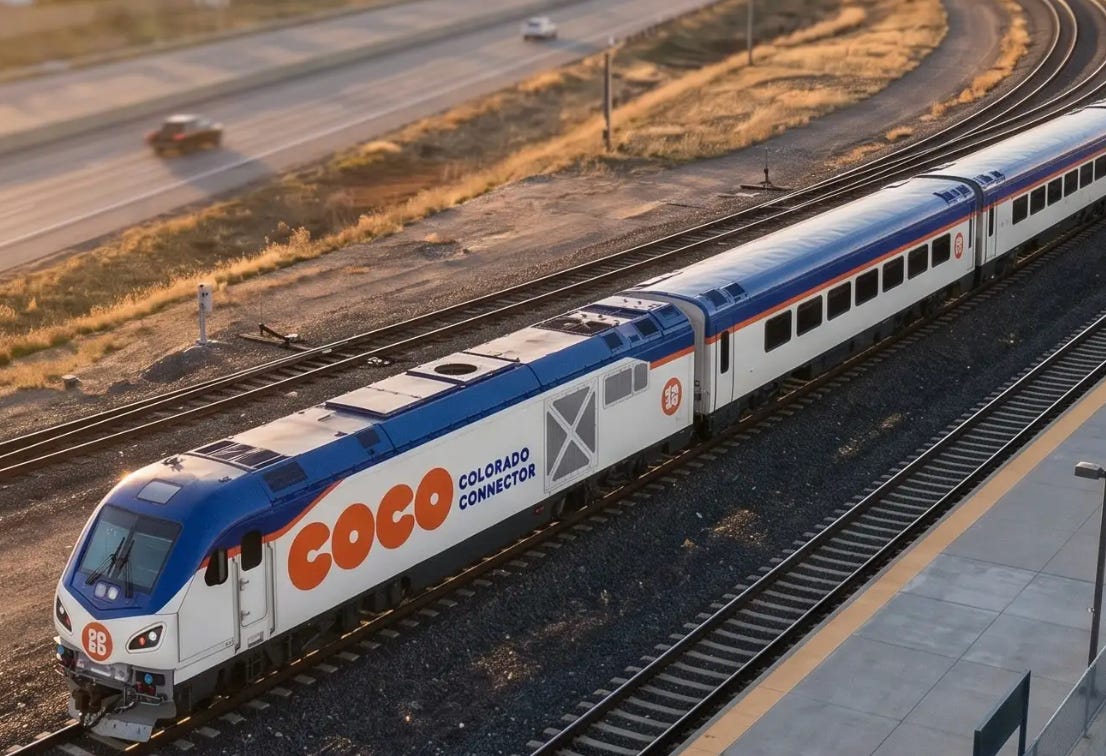
Artist’s Rendering of Colorado Connector service (Image: Colorado Connector)
In Colorado, voters approved a new tax to help bring passenger trains to the Front Range, connecting communities from Fort Collins through Denver to Colorado Springs and Pueblo. In the San Francisco Bay Area, voters approved new funding to preserve and improve service on BART, Caltrain, Muni, and AC Transit. Seattle voters renewed and expanded their investment in transit. And smaller communities across the country voted to preserve the buses that get their neighbors to work, school, and medical appointments.
Now look, I’m not pretending to know precisely what motivated every voter in every one of those communities. And it’s probably worth noting here that a few measures failed and that, yes, transportation taxes do affect household budgets. Even so, I think there’s something important burbling up here in this pattern, and I think our national discussion about affordability is missing it.
According to new figures released by the Bureau of Labor Statistics just last week, American households spent an average of $13,492 on transportation in 2025. That’s 16.5 percent of household expenditures...the second-largest category after housing! Americans spent more on transportation than they did on food.
A lot of campaign talk this year has been, correctly, about housing affordability. But a house with a manageable mortgage or reasonable rent can turn out to be anything but affordable if living there requires two cars, hours-long daily commutes, expensive insurance, maintenance, and gasoline. A better-paying job isn’t much of an opportunity if getting there eats up much of the additional income. (Ask me how I know: I used to live two hours and 17 minutes away from DC even though I worked downtown.) And a family that can’t reliably reach a doctor, a grocery store, or a childcare provider? Well, those costs go well beyond dollars and cents.
It’s especially galling to me when highway apologists point to the volumes of car traffic and automobile journeys as proof that most Americans “choose” cars. For millions of Americans, owning a car isn’t really a choice. It’s the price of admission to everyday life. And when we fail to provide alternatives, we’re effectively telling those families that they have to shoulder that burden themselves.
So that’s why I think Yonah’s observation deserves to be turned around. Maybe voters weren’t supporting transportation investments despite their concerns about affordability. Instead, let’s consider that maybe some of them were doing so precisely because of those concerns.
A modest increase in a local tax might well be a worthwhile trade-off if it helps a family avoid buying another car. Reliable rail and bus service can expand the number of jobs people can reach, the communities in which they can afford to live, and the opportunities available to their children. For older Americans and people with disabilities, mobility can mean the difference between independence and isolation. And for communities that have spent decades waiting for better passenger rail connections, those investments offer something we don’t talk about nearly enough: access to a wider economy without requiring everyone to drive everywhere.
There’s another lesson here, too, I think; perhaps subtle, but it’s there. Americans who worry about government corruption aren’t necessarily unwilling to invest public money. But they have every reason to expect that money to be spent wisely, transparently, and on services that deliver tangible benefits. Passing a ballot measure is only the beginning. Actually delivering the promised mobility, making a material difference in the life of the voter, is what earns lasting public confidence.
As Sean pointed out yesterday, Congress will soon get another chance to rethink America’s transportation priorities as it takes up the next surface transportation authorization to replace the Infrastructure Investment and Jobs Act. We’re going to do our best to help lawmakers pay attention to what voters just told us. For me the message was pretty clear: transportation can’t remain a footnote in the national conversation about the cost of living. It’s just foolish to keep treating housing, employment, economic development, and mobility as though they live in separate universes.
And we certainly can’t keep measuring the cost of better transportation without also measuring the enormous cost of doing without it. Because the cost of doing nothing is real. Families pay it every day, whether it shows up in their car payments, their gasoline bills, their lost time, or the opportunities they simply cannot reach. Affordability isn’t just about having enough money to live somewhere. It’s about being able to afford to live your life once you get there, and talking about affordability without talking about mobility leaves a lot out of the conversation. It’s not possible. They go together. And that’s why transportation needs to be one of the top areas in which the new 120th Congress goes to work.
Jim,
I have been saying this for years.
Almost everything we do in life requires the mobility to access it. It is the essence of our freedom.
Investing heavily in passenger rail and regional transit has a direct impact on all of this.
I have also been arguing this point, including here on Miami Beach with its paucity of Affordable housing YET poor transit connections to the mainland with its moderately cheaper housing.
Jim's argument dovetails with an aspect of ReThink NYC's throughrunning advocacy, namely that it opens overlapping pools of jobs and less expensive housing with a one seat ride, creating a vast opportunity pool unlike current balkanised arrangements.
Higher speed connections also-obviously-bring jobs and housing closer together.