


Union Pacific and Norfolk Southern are asking the Surface Transportation Board for permission to create the first coast-to-coast freight railroad in the modern era. As I’m sure you’ve read by now, that’s a really big deal...and the consequences will outlast everyone currently sitting in a railroad boardroom or a federal office. So today Rail Passengers filed our full comments asking the Board to deny the merger as proposed.
We did not arrive here because freight railroads are bad, mergers are always bad, or change is frightening. We arrived here after reading what UP and NS filed, reading what they filed again after the Board asked for more, and then looking for an answer to one pretty basic question: how will all those additional freight trains interact with the passenger trains already running on the same network? Months into this case, the answer is still mostly a stack of tables, assurances, and promises to keep an eye on things.

That may sound like railroad inside baseball. But I promise you it’ll feel considerably less academic when your train is sitting outside Chicago, New Orleans, Atlanta, Pittsburgh, or somewhere in the Arizona desert because the railroad built its merger plan around freight growth and treated passenger trains as scenery.
Today’s filing is the next stage of the case we began making in September. Our first filing argued that UP and NS had failed to make even the basic passenger-rail showing required for the case to move forward, so we asked the Board to drop it -- in legal lingo, we moved for summary denial. The Board declined to end the proceeding at that stage, but carefully left the merits arguments open and making clear that it had not blessed the applicants’ arguments or analyses. Fair enough. The Board wanted a fuller record. We have now supplied our part of it.
(NOTE: You can follow this link to read or download our entire filing from the STB’s UP/NS docket, FD36873. Or, you can follow this link to our filing here on our own site.)
If all you knew about this takeover attempt by Union Pacific was what you read in the paper or saw on TV, you’d think this has nothing to do with Amtrak, commuter rail, or any kind of passenger trains. But the effects on the trains we need could be enormous, and that reality is still, unfortunately, not really cracking the headlines. At least not as much as remarks by UP chief Jim Vena at a shippers’ conference, now forced into the public eye by an STB order.
Passenger rail belongs in this merger case because the statute and the Board’s own rules put it there. Major-merger applicants must explain whether transportation to the public will remain adequate. They must describe how increased freight traffic will affect Amtrak and commuter trains, coordinate with passenger operators, and plan infrastructure for future growth. Congress and the Board did not tuck those requirements into the rules as decorative trim. Congress actually defines “transportation” as including, explicitly, passenger rail and not just freight movement.
The Board identified the missing issue months ago and gave UP and NS several ways to address it: provide a dispatching plan, model the trains, analyze likely freight schedules, or offer some other operating evidence that shows how the combined network would function. The railroads responded with capacity tables, historical monthly averages, references to existing legal duties, descriptions of meetings, positive press statements, and assurances that they will monitor problems after the merger. Useful information, perhaps, but none of it tells us when the added trains will run, where they will meet or pass passenger trains, whether crowded terminals can receive them, or who gets held when the plan runs out of room, and none of it is as good as commitments in the official docket that STB can enforce.
UP has said that a full Rail Traffic Controller simulation for a network this large would take many months and cost millions of dollars. I believe them. I’ve seen “under the hood” what it takes to do RTC modeling and it’s a giant, and multi-million-dollar, undertaking. I also believe that a company proposing a merger of this size should anticipate that homework before starting the regulatory clock. In any event, the Board offered narrower choices than just RTC. The applicants could have modeled representative high-risk corridors, disclosed likely operating windows and directional flows, reconciled their line and terminal assumptions, or produced a passenger-specific dispatching plan. They chose none of them.
The baseline hardly inspires a relaxed, nothing-to-see-here attitude. Amtrak’s September Host Railroad Report sets a target of fewer than 900 host-responsible delay minutes per 10,000 train-miles. UP posted 1,289 in September and 1,080 over the previous 12 months. NS posted 956 and 909. Both missed the target on both measures, and freight-train interference was frequently the largest delay category on routes the merger would affect. Adding traffic to a strained network and promising to monitor the outcome is a little too much like starting dinner and buying the smoke detector afterward.
Our filing uses several corridors to show what the problem looks like on the ground. These are examples, not the full inventory of possible harm. UP and NS list many more affected routes and terminals. Their failure to provide timetable-based modeling means that the Board, passenger operators, state sponsors, and the public still cannot see the outer boundary of the risk. The maps below, developed by our in-house data and research team, simply plot some of the applicants’ own traffic and project data. They don’t simulate operations, and nobody should read the unmarked portions of the network as a clean bill of health.
Chicago is the most obvious network example. UP and NS project five additional daily freight trains between Chicago and Porter, Indiana; seven more between Porter and Toledo and between Toledo and Cleveland; and large changes elsewhere in the terminal. That includes 14 additional trains on Metra’s UP-West corridor between Kedzie and Proviso. Chicago already asks a great deal of dispatchers, junctions, yards, commuter schedules, Amtrak trains, and connecting passengers. The merger application never assembles those moving parts into one passenger analysis. Apparently the nation’s busiest rail terminal is supposed to work it out in real time.
The Pittsburgh-Harrisburg corridor offers a different lesson. UP and NS project seven additional daily freight trains over the Pittsburgh Line. Just two days from now, Amtrak and PennDOT will launch a second daily Pennsylvanian round trip after years of planning and more than $200 million in contemplated infrastructure and safety investment. Norfolk Southern deserves real credit for helping to make that expansion possible. But, that success also shows why the word ‘sufficient’ in a table describing capacity can’t explain how seven new freight trains will fit without consuming the operating margin the public just paid to create.
New Orleans gives us one of the most arresting numbers in the record. Every existing Amtrak service using the city traverses some part of the Back Belt, where the applicants project eight additional freight trains each day. Between New Orleans and Oliver Junction, their own table shows 20.0 trains per day against a stated fluid-capacity threshold of 20.1. That works out to 99.7 percent utilization and a cushion of one-tenth of a train per day. One-tenth of a train is not much of a cushion. It’s closer to a rounding error with a big headlight...
The applicants point to track configurations and planned crossovers. Those may help. They also reinforce the need to show the actual operating plan. When a future project is doing essential work in the merger case, the Board should know when it will be finished, how much capacity it creates, what happens if it slips, and how passenger trains will be protected in the meantime.
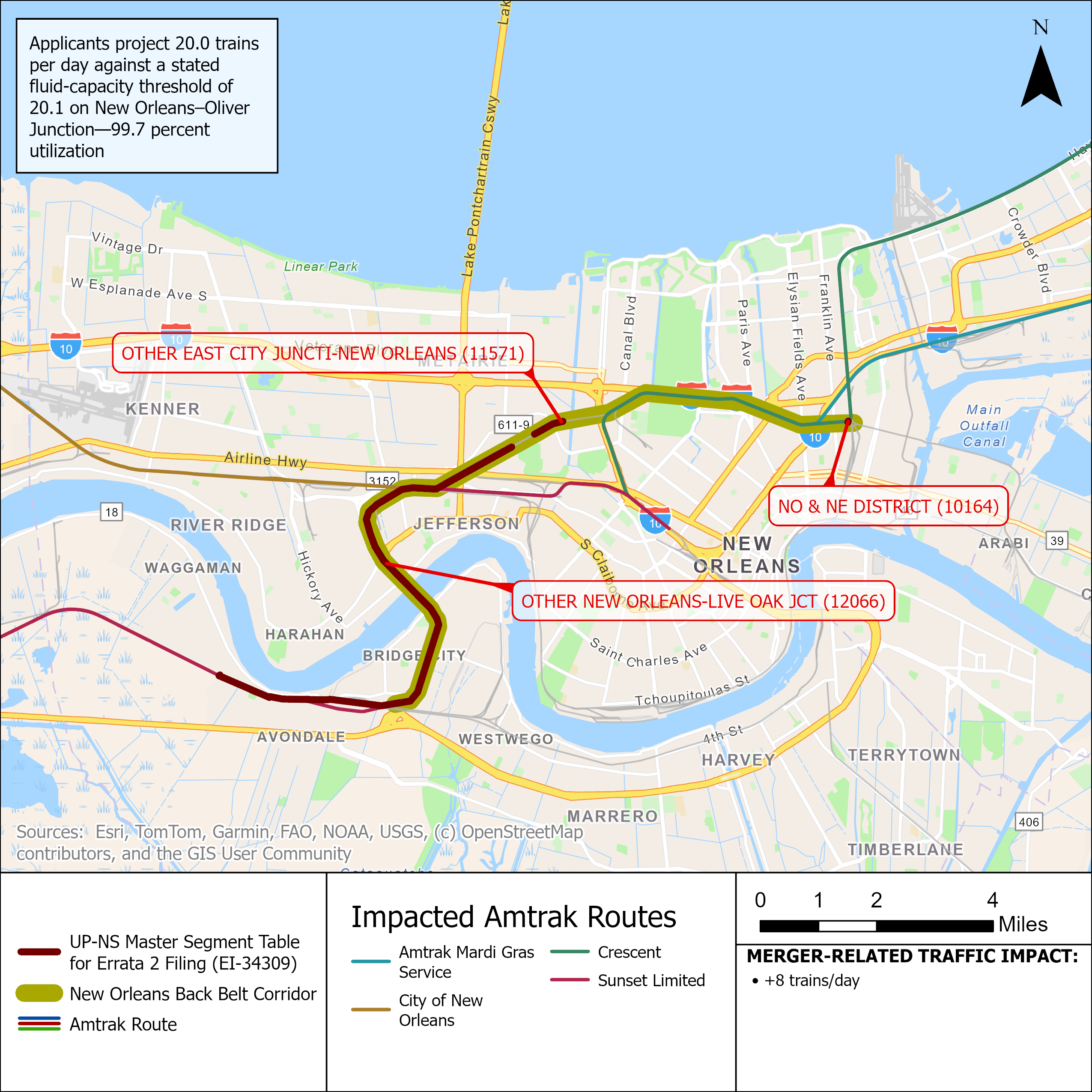
New Orleans Back Belt: eight additional daily freight trains and a stated New Orleans-Oliver Junction utilization of 99.7 percent. (Map Graphic by Rail Passengers Staff)
Between Meridian and Atlanta, the applicants project ten additional daily freight trains on the Crescent route, one of the largest passenger-corridor increases in their tables. They list several capital projects that may prove useful. A project list leaves some rather important blanks: how much capacity each project creates, when it will open, which assumptions support it, what happens if it is delayed, and how the Crescent and future passenger growth will be protected. Dots on a map don’t dispatch trains.
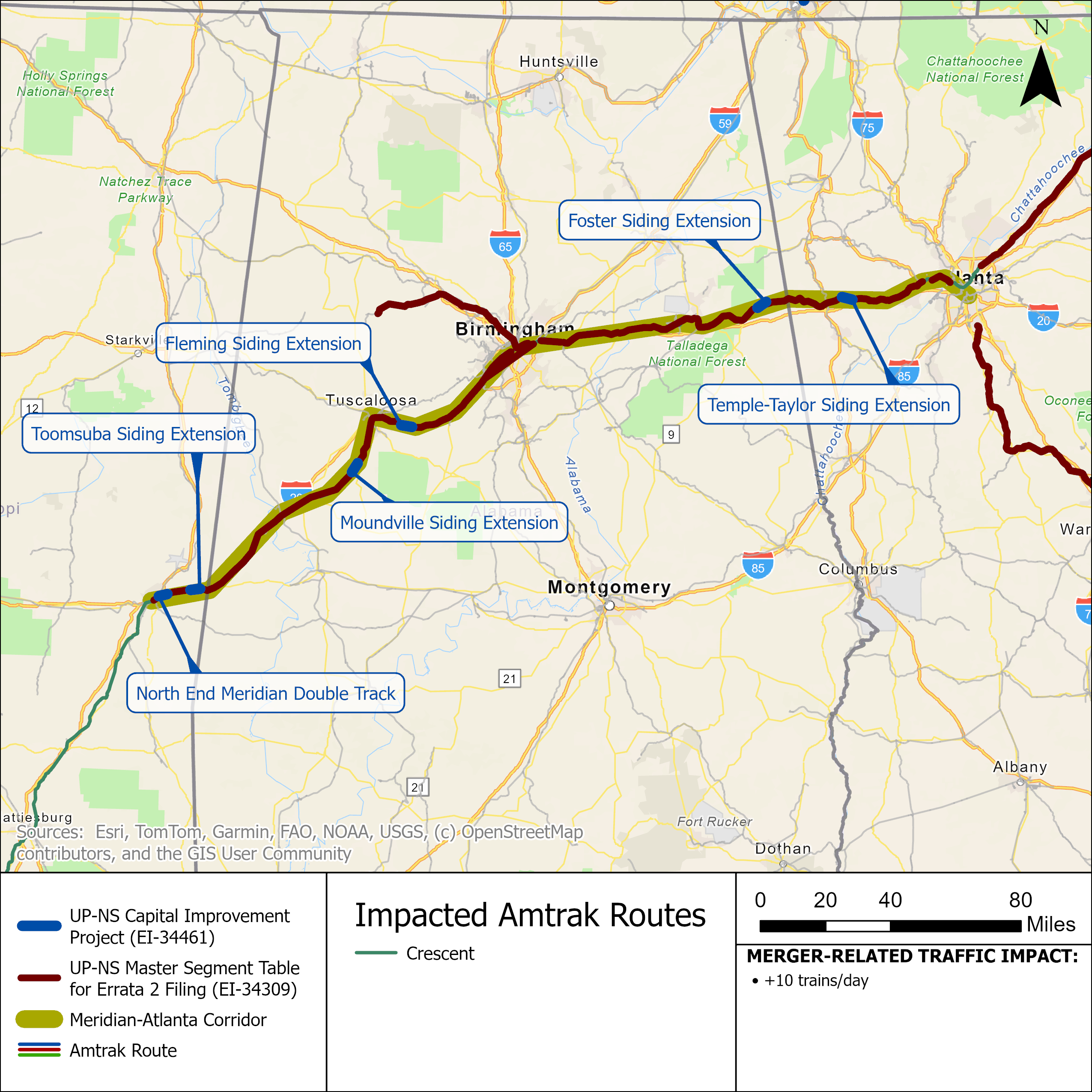
Meridian-Atlanta: ten additional daily freight trains on the Crescent corridor and the capital projects identified by the applicants. (Map Graphic by Rail Passengers Staff)
The Sunset Limited manages to illustrate present trouble and future risk at the same time. The applicants project two to eight additional daily freight trains on segments used by the train. They report 94.2 percent projected utilization on one segment and show Growth Plan traffic exceeding present fluid capacity elsewhere by Year 3. Their higher capacity threshold assumes that the Mohawk-Stoval double-track project will be finished by the end of Year 2. Meanwhile, UP produced 1,186 host-responsible delay minutes per 10,000 train-miles on the Sunset Limited in September, with freight-train interference again the largest category. Passengers have already contributed quite enough to this experiment.
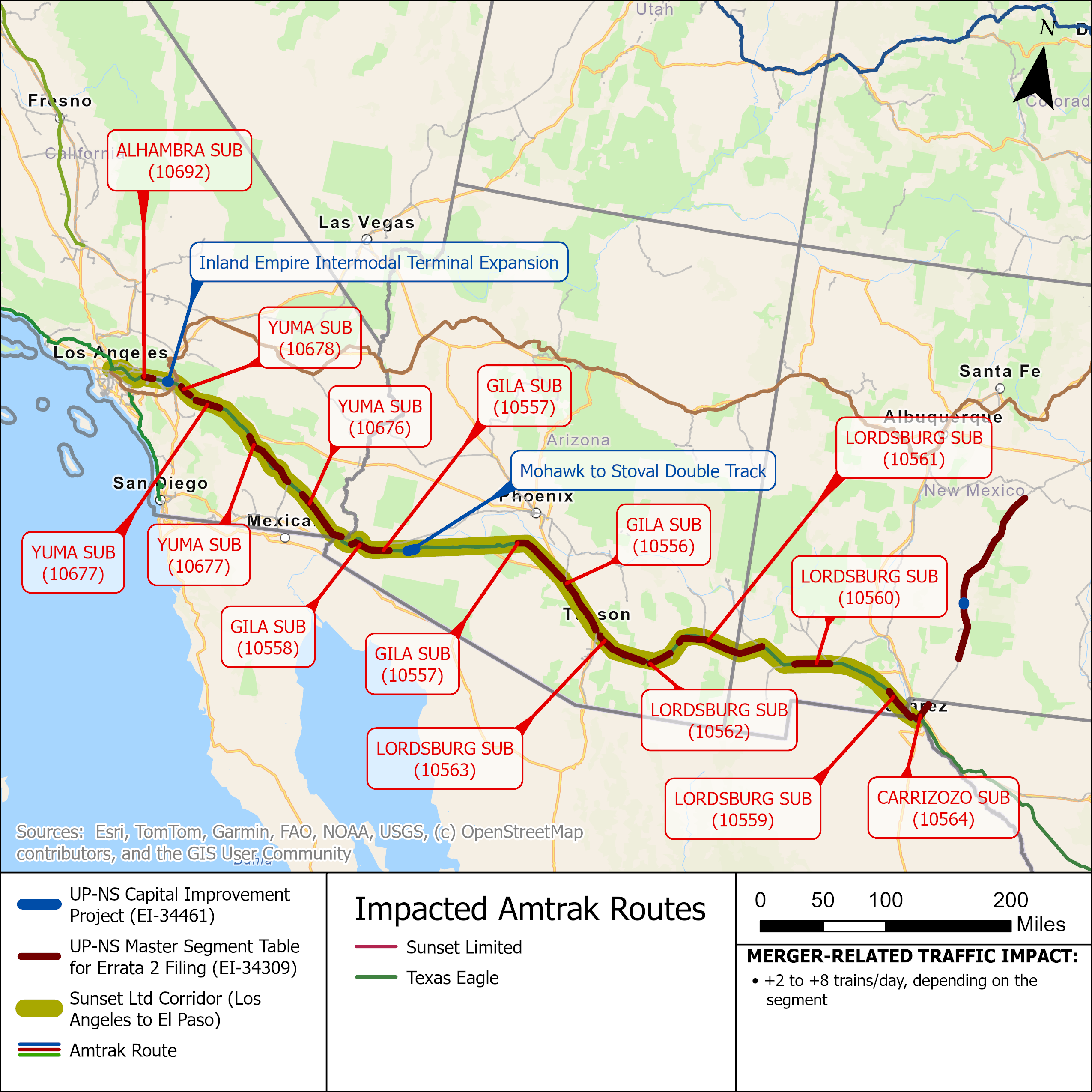
Western Sunset Limited corridor: two to eight additional daily freight trains, with future capacity tied in part to the Mohawk-Stoval project. (Map Graphic by Rail Passengers Staff)
UP and NS lean heavily on a statistical study they commissioned by Dr. Kristof Zetenyi, which they use to argue that higher utilization has not historically produced a measurable increase in passenger delay. Statistical evidence deserves a fair hearing. This study cannot carry the load the applicants have put on it.
The study accepts the applicants’ capacity inputs and selected segments without independently validating them. For each passenger service, it takes one selected segment and compares that segment’s utilization with delay across the entire route. A train can pick up delay at a terminal, yard, junction, or another line hundreds of miles away, which makes that pairing a peculiar way to test a local capacity question. The study also pools very different services, climates, train mixes, and operating practices. Nine of the 25 passenger services have no historical month at or above the projected post-merger utilization level. Five more have fewer than five such months. Adding rows to a spreadsheet does not magically manufacture route-specific operating experience.
The main estimates are positive, but statistically imprecise. The available data can’t confidently distinguish the estimated effect from zero, and they certainly don’t prove that the true effect is zero. One nonlinear test even found a statistically significant difference when utilization moved from the 90-to-100 percent range into the 100-to-110 percent range, only for the study to discount the result through a different comparison. Monthly averages also wash away the very things dispatchers have to manage: time of day, direction, train length, speed, maintenance windows, meets, passes, and terminal congestion. Statistics can supplement a real operating demonstration, but by themselves they can’t conjure one or replace it.
The application has another odd feature: it looks forward whenever future freight growth or a future capital project helps the merger case, then becomes suddenly bashful about the future when passenger growth enters the picture.
Congress created the Corridor Identification and Development Program to develop restored routes, new corridors, added frequencies, and improvements to existing service. Of 69 federally selected projects, our analysis found that 43 potentially use UP or NS infrastructure, and 22 overlap at least one segment where the applicants project more freight traffic. Future forecasts carry uncertainty on both sides of the ledger. The Board should require transparent assumptions, sensitivity tests, protected capacity, and enforceable milestones for both.
The same common sense applies to taxpayer-funded infrastructure. Capacity created by Pennsylvania, Virginia, North Carolina, the Federal Government, or another public partner does not become a merger benefit merely because the combined railroad would like to use it. And by the way, that’s not just my opinion; that’s how the merger rules work. When UP and NS rely on a public or third-party project to make their Growth Plan work, the combined railroad should preserve the passenger capacity that investment was designed to create and replace it if the project is delayed, changed, or canceled.
The Board has also warned against treating silence as consent. In Decision No. 45, it expressed serious concern that public remarks by UP’s chief executive could affect whether stakeholders feel free to participate without fear of commercial consequences. Our filing asks the Board to draw a narrow, practical lesson. Passenger operators, state sponsors, commuter authorities, and corridor planners depend on their host railroads for dispatching, access, studies, agreements, and future negotiations. Some organizations may decide that filing public criticism carries more risk than staying quiet. Their silence tells the Board very little about whether UP’s takeover of NS is good for passenger rail.
Our preferred remedy is denial. Why? Because the applicants have not carried their passenger-rail burden as laid out in the regulations and the governing statute. Now, if the Board approves the transaction anyway, we want enforceable conditions rather than another round of warm assurances. Those conditions should preserve existing passenger rights and successor obligations; require route- and terminal-specific operating demonstrations; establish performance floors, public reporting, and objective triggers for intervention; speed up dispute resolution; protect Corridor ID projects and taxpayer-funded capacity; prohibit retaliation; and keep the Board involved when the promises meet the timetable.
Freight growth and passenger growth can share a railroad when the planning is honest, the capacity is real, and the operating plan survives contact with an actual timetable. UP and NS may eventually demonstrate that their merger meets that test. Their current application does not. A transaction of this scale deserves better than “trust us, we will watch it.” Passengers do too.
Excellent analysis. Thanks, Jim.
Jim, Thanks to you and all the staff for keeping a boot on their back on this. All the best for the Thanksgiving holiday.