


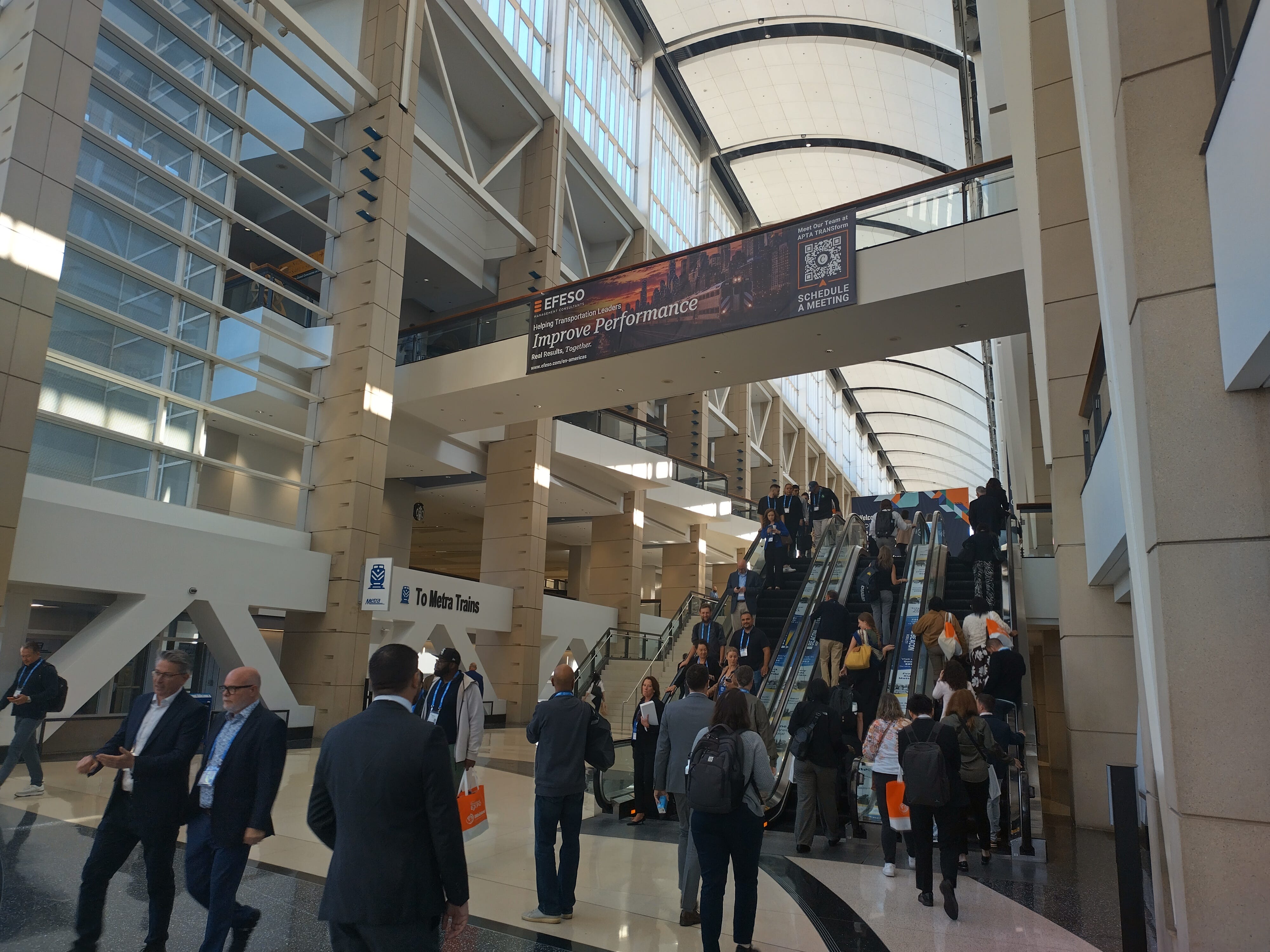
Last month, after RailNation wrapped up in Toledo, I spent two days at the American Public Transit Association’s TRANSform Conference & Expo in Chicago. Overall it was an excellent meeting, with a lot of familiar faces and productive interactions among our fellow rail and transit professionals. Jim Mathews previously offered his own reflections from the meeting, but I wanted to take a moment to contemplate what we’ve learned and talk about the state of the rail and transit industry more thematically.
In this installment we’ll be focusing on some positive developments and encouraging observations about the industry’s capabilities. In another piece coming soon we’ll look at some of the challenges the industry faces as it moves into the future. But a big idea that spans both will be an idiom that originated from the German railways and has migrated across the Atlantic: “Operations before electronics before concrete.”


Promising Agency Updates
The most prominent takeaway from the whole meeting was that rail and transit professionals genuinely care about their mission of moving passengers from A to B, not just efficiently but with quality service. That care was on display in a Tuesday morning panel on regional rail, where we were treated to some excellent news from multiple agencies.
Prabmeet Sarkaria, Ontario’s Minister of Transport, opened the proceedings by describing the results of $70B in capital investments planned over the next decade across the TTC and GO Transit networks. The centerpiece project consists of upgrades to Toronto Union Station allowing it to serve 80 trains per day. But Minister Sarkaria punctuated those broad-scale visionary projects with anecdotes from individual passengers, including a single mother whose commute had been reduced from nearly 2 hours to just over 15 minutes by a recently-completed project.
The panel was anchored by Justin Vonashek and Brett Ulrich of Metro North Railroad, who provided a tag-team overview of how incremental projects on their network have led to extraordinary results for the passenger. There are of course major capital projects underway at Metro North, including the purchase of 33 new dual-mode locomotives, completing renewals on the Park Ave viaduct, and new stations served by the Penn Access project.
But the most fascinating discussion focused on operational improvements. Metro North has worked with the US Coast Guard to guarantee no moving-bridge operations during peak travel times, so that trains need no longer stop for boats. They’ve also taken advantage of newly-installed Positive Train Control to eliminate overly restrictive speeds imposed by block signaling. A 3-mile-long signal block that would have previously been restricted to 45 mph along its entire length can now be gradually stepped down to 70 mph, then 50 mph, then back up to 70 mph while the train is still in the signal block, saving nearly 1 minute per block. That improvement has dovetailed with replacing old electro-mechanical signal decoders with solid-state decoders, allowing a new 270-Hertz signal frequency in the track circuits. This increases the number of possible speed settings in the cab signaling system from 4 to 5, allowing some sections previously restricted to 45 mph to now run at 60 mph.


These operational changes have enabled Metro North to introduce new Super-Express timetables, from Poughkeepsie and New Haven to Grand Central in under 90 minutes, the latter of which is 25 minutes faster than the fastest Amtrak timetables from New Haven to Penn Station (you can double-check yourself with our timetables produced by Chris Juckins). Moreover, these operational efficiencies have helped Metro North to secure recurring financial savings, with today’s operating costs being lower than those in 2019 in real terms. Combined with higher ridership and continuously improved on-time performance, this has significantly averted the fiscal cliff the MTA has been staring down for the last few years.
I wish the presentation had been recorded. Our members in New York and Connecticut would have loved to see it, but I also think some of our advocacy colleagues outside the Association could afford to internalize its implications. Recall that German phrase: “Operations before electronics before concrete.” While some transportation thought leaders in the USA often interpret that phrase quite literally – to suggest that we shouldn’t be making major capital investments in fixed infrastructure as long as we retain outdated operating practices – Metro North has demonstrated the practical benefits achieved by improving operations, electronics, and concrete infrastructure all at the same time.
Scouting for Tools
Wandering around the exhibit hall, I got a sense of what it takes to implement those operational improvements. Besides taking in all the neat hardware on display (only some of which I got pictures of) I spent a lot of time talking with exhibitors for data analysis software. Even though the Association already has software tools that are more than adequate for our needs, I still like to keep tabs on what my fellow data scientists are doing across the industry & maintain familiarity with what new products are out there.


I stopped at about half a dozen vendors for CAD/AVL (Computer-Aided Dispatch / Automated Vehicle Location) systems. These are the tools transit operators use to integrate data received from buses & trains across their system, both to be converted into useful real-time information for passengers on smartphone apps and information screens, and to help agency planners assess the performance of their vehicles and routes. Like much of the specialized software industry, this is a field where newer firms start up, grow from a few early clients to larger support operations, then get bought by established firms with wider portfolios.
I first ran into one of the newer entrants, based in Canada but with customers across the continent including Denver’s RTD. After exchanging amusing anecdotes from our respective experiences working with ArcGIS (a digital mapmaking program) in school, their staff explicitly invited me to go look at two of their competitors’ products and report back if I had any constructive comparisons. The first of those competitors, by coincidence, manages the data for two of the transit agencies that operate where I currently live, and their technicians were glad to show me their interface where I could see how many riders got on or off at any given bus stop in the county over time, as well as the state-of-repair of the shelters and benches at those stops. At the second competitor, the representative was initially very excited to show me all of their integrated AI features. After I admitted my preference to do my analysis manually, he let out a big sigh of relief, said something like “oh thank goodness, you’re sane, we can skip all this & look under the hood at the stuff for advanced users.” We then we spent about 15 minutes scrolling through data tables and mutually lamenting how badly we were taught linear algebra. Can you tell we’re all huge nerds?
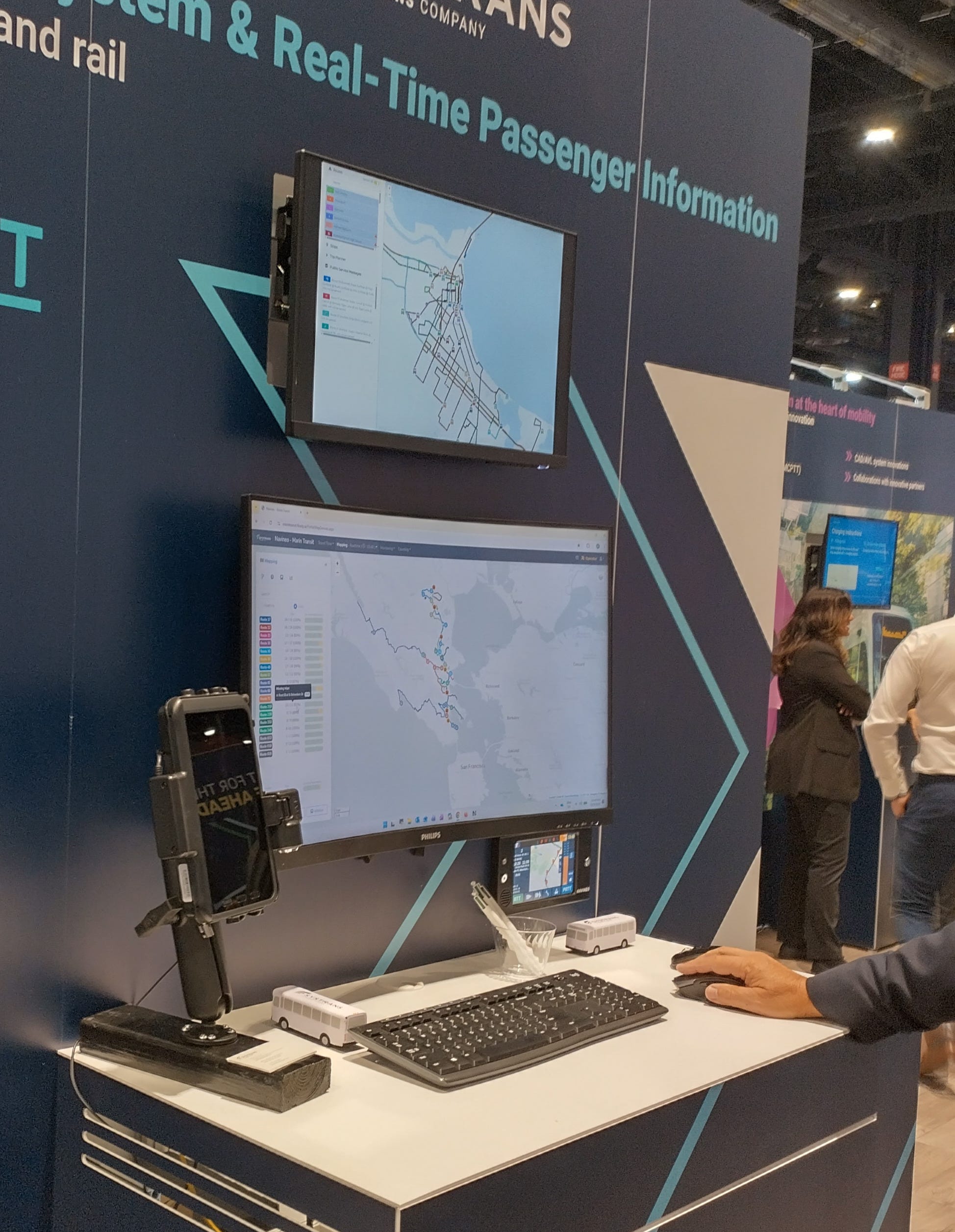
A few of the other vendors had a greater focus on data support for rail operators, particularly traffic management and timetabling. I asked them all the same question: how do their capabilities compare with RTC Modeler, the dispatching simulation tool used by all the Class I freight railroads? Most had never heard of this tool, presumably because it is both old and highly specialized for the US freight rail industry. But they all demonstrated the ability to build a route diagram, plan a timetable for a new passenger train, and calculate the necessary adjustments to other trains’ track authority to accommodate the new train. I don’t think I’ve ever looked at as many stringline diagrams in any 24-hour period.
But even with so many firms building similar tools, they all had good things to say about their competitors, whether they were a big player like Deutsche Bahn’s consulting arm or a boutique firm supporting UK open-access operators. By analogy, if an agency has trains built by both Hitachi and CAF, those vehicles need to be able to work together at least to some degree, and therefore so do their engineering teams. Similarly, agencies often choose one software provider for one data analysis need and another provider for another need. In that situation, the two software programs need to interface seamlessly, not just between IT offices but also between computers on the same vehicle. To paraphrase a German UX designer I spoke with: “At the end of the day, we care less if you use our product or someone else’s, than that you’re serving your passengers well; and if you’re here at APTA, that says you really care about that mission.”
The Takeaway
It turns out, hard problems can be solved. Even if the average passenger doesn’t have a clear sense of how to eliminate the everyday inconveniences along their journey, there is an entire industry of professionals who do, encompassing both those building the tools to optimize a railroad’s operations, and those creatively deploying those tools in conjunction with the operating agency’s other systems and capabilities.
But in this same Regional Rail forum, there was another story about investments in fixed infrastructure not being made, how new technology is stepping in to fill that need, who isn’t at the table making those decisions, and whether their outcomes make economic sense. That story is worth a deeper dive, so stay tuned for a Part 2 coming soon to The Data Junction.