


In agriculture, the consensus wisdom states that monocultures will increase productivity through efficiency gains in the short run, but in the long run increases exposure to massive failure through susceptibility to diseases and pests.
I had time to mull this thought over at the airport last Saturday, waiting to see if my flight would actually take me where I needed to be, one day after the largest and longest disruption to US air service since the September 11 terrorist attacks. Not everything is a metaphor… but some things are!
As my phone was buzzing with stories from friends in a similar or worse state of limbo—one driving 18 hours from San Francisco to Denver after four cancelled flights, another indefinitely hosting an in-law who had been grounded in Washington, D.C. on the final leg back to upstate New York—I ended up getting pretty worked up about the pitfalls of living in this kind of brittle system.
What made sitting in the wreckage of these policy failures worse is the knowledge that we are currently in the midst of a debate over the surface transportation reauthorization where some of the most important members of Congress are saying we need to double down on this lack of resiliency. More highway congestion, less transit, fewer trains. Oh, and to top it all off, we’re probably going to deficit-fund this highway expansion. The definition of insanity…
However, that’s simply the story U.S. policymakers are telling themselves. In the real world, displaced passengers were scrambling for alternative modes, grabbing up the last available Amtrak tickets. Think how much better it would’ve been if other parts of the country had levels of train service comparable to the Northeast Corridor.
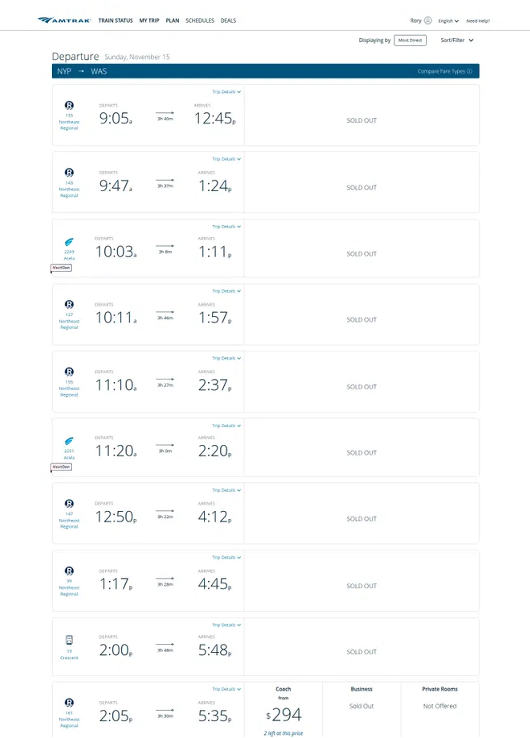
(Apologies to the stranger who posted this screengrab on the internet.)
Many of these thoughts ended up in a coworker group chat, at which point my boss reminded me that I worked at a transportation advocacy organization and I have more productive channels for expressing my frustration. Which leads me to the main point of this piece:
Don’t Let Building a Better Air Traffic Control System Become a Reason Not to Build a Better Transportation System
In our Association’s meetings with Congress over the rail title in the upcoming surface transportation reauthorization, we’ve heard repeatedly that offices expect the air traffic control (ATC) modernization to “suck up a lot of the oxygen in the room” (Nb. ATC is authorized as part of federal aviation reauthorization legislation and moves separately from the surface transportation bill). The most obvious way to read this statement is “train advocates shouldn’t get their hopes up.” It is abundantly clear that many view the Infrastructure Investment and Jobs Act’s (IIJA) rail title as a “once in a generation” investment.
However, all the arguments for why the federal government can’t continue to invest in passenger rail are nowhere to be seen when there’s a disruption to the publicly-backed aviation system. No one wrings their hands asking, “how are we going to pay for it?” No one says, “it’d be nice to have a functional ATC system—but if Americans wanted it, then the market would provide it.” No one opens negotiations by saying, “we’ll provide funding for a modern ATC where it makes sense, but the smaller airports and the rural states are just going to have to make do with driving long distances and intercity buses.” None of this happened because previous generations of Americans had done the hard work of building out our country’s aviation system to the point where it was able to support a significant user base; so now, when it fails, tens of millions of people are seriously inconvenienced and our institutions take note.
What happened instead was the Secretary of Transportation stood in front of the nation and demanded Congress provide $30 billion to modernize the system. And then, the very next day, demanded Congress provide $50 billion to modernize the system. Which, it’s worth noting, would come on top of the $12.5 billion Congress provided for ATC modernization in 2024.
Which leads me to the second point of this piece:
We Need a Competent and Transparent Department of Transportation to Have a Functioning Transportation System
As Americans know all too well, shoveling money at a project won’t do a bit of good if there’s not a good plan on how to spend it. While I’m no expert on aviation, people who spend more time tracking ATC modernization have pointed to a troubling pattern of inaction on distributing ATC modernization funds appropriated by Congress. While this timeline is far from exhaustive—and compiled by a member of the opposing political party—it’s impossible not to notice similarities between the management of the ATC system modernization and what passenger rail advocates have seen out of the U.S. Department of Transportation over the past few years:
Billions of dollars of unspent grant money, with a nonsensical rationale on why distribution of funds is being delayed? Check.
Funding decisions that seem more motivated by politics than strategy? Check.
A series of shifting programmatic goalposts leading to uncertainty and delays? Check!
Congress is going to have a packed transportation docket in 2027. Not only does it need to find the next tranche of funding for several critical programs, it is also going to have to resume its constitutionally mandated oversight duties to ensure that the Trump Administration is actually spending these taxpayer dollars on the programs Congress established.
Which brings me to my final point:
America Needs Trains, Planes AND Automobiles
Our country absolutely needs a modern ATC system. But that’s not enough. It also needs a modern intercity rail system. And better transit and safer highways. If we don’t build a balanced system with redundancies, travel for Americans is going to get a lot worse over the coming decades.
Here are some suppositions which I believe to be well-founded:
The war with Iran and conflict in the Strait of Hormuz has led to a spike in oil prices, which in turn led to higher jet fuel prices. Regardless of what happens in the Middle East over the next few months (years?), these fuel prices will not return to 2024 levels anytime soon.
Whatever happens with electric automobiles, we’re not anywhere close to electrically powered commercial air travel.
Severe weather disruptions will continue to increase, making airplanes more difficult to operate and more prone to disruptions.
All of which is to say, the fundamental economic inputs of consumer air travel are changing, and it’s going to price many people out of that market. Intercity rail has a critical role to play in preserving affordable mobility—particularly between city-pairs under 500 miles and along rural corridors. But we have to build out the US rail network to create that resiliency in the system.
The other alternative is everything continues to get slightly worse, year after year. People travel home for Christmas but not Thanksgiving. Families take one vacation per year, not two. Business travelers settle for Zoom calls.
Fortunately, the choice still lies before us. Rail Passengers is already planning out the fight for more and better trains in 2027. We hope you’ll join us.
AMEN to all of this!