


Being a passenger-rail advocate can sometimes feel like a long slog. We’re often told to wait decades for anything positive to happen. And that’s not a recipe for getting folks to fight the good fight for a long time. But this week really underscored for me that good things really ARE happening, and we’re starting to see seeds planted decades ago all finally flowering at once.
I started the week in New York City at Penn Station, where we celebrated what really deserves to be called an impressive 14-month sprint to refurbish the hurricane-damaged Line 2 tube in the East River Tunnel. Just 14 months to reverse 116 years of neglect! Fourteen months to pour 24,000 feet of benchwall, replace everything down to the liner, set new track, re-signal, and all the rest.
When I made my remarks from the podium, I told the assembled New York press that as much as New Yorkers might have felt that this took a long time, 14 months feels like Mach 12 in a country where we took 19 years and 11 months to restore two trains a day between New Orleans and Mobile on tracks that were already carrying trains.
And yet, that train – the Mardi Gras – represents extraordinarily good news, too. As I stood there in New York, it was exactly one year and one day earlier that I rode the first Mardi Gras on a celebration tour from New Orleans to Mobile and back. The crowds were huge, and the joy was so obvious you could taste it. These were not just railfans with big cameras. These were ordinary people thrilled to be able to use the train to see family, to see friends, to do leisure travel, to commute, and to explore the incredibly rich Gulf Coast’s restaurants, lodging, casinos, museums, and natural beauty.
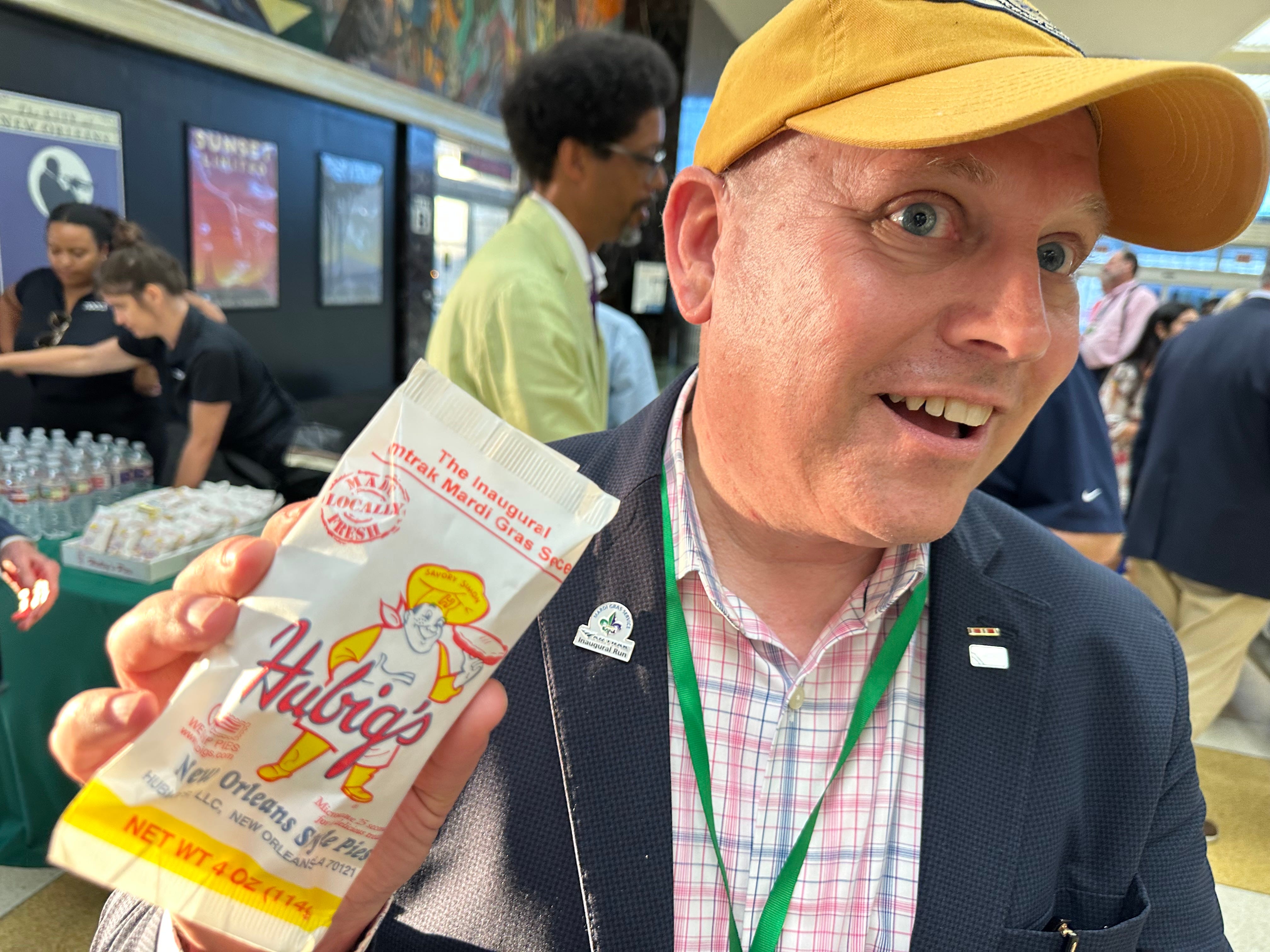
Yes, I’m a sucker for stuff like this; a highlight of the inaugural Mardi Gras ride for me last year was this extremely healthy New Orleans-style pie. (Image credit: Author)
When the “Mardi Gras” name first leaked, a lot of the railfan community howled. Some thought it was silly, others thought it sent the “wrong message.” But a year ago when I replayed my 2016 inspection train ride, following the costumed second line on to the train in New Orleans, shaking hands and sipping the champagne handed out by the locals in Bay St. Louis, Miss., talking with giddy revelers dressed in ever-more-outrageous costumes, and hearing all of them talk about what they planned to do on their own “first trips,” it was abundantly clear: “Mardi Gras,” the name, was a stroke of marketing genius.
As a visible symbol of what this simple twice daily service will do for the served communities, it’s pitch-perfect. It captures exactly why this train is succeeding, wildly. It was a shared effort across Gulf Coast communities, to bring about a shared vision, to connect their shared culture. After riding the train both ways, I had no worries at all about whether the train will attract riders. It’s generally sold out for a few weeks, and if you want the $15 fares you’ll have to book in advance.
Before the Mardi Gras service kicked off last August, Amtrak predicted annual ridership of just 71,000 passengers. Ever since the first train rolled, the Mardi Gras set a pace to far exceed that estimate, carrying 59,000 passengers by the end of calendar year 2025, reaching 70,500 by the end of January, and reaching 150,000 by its one-year birthday. A few thousand more will hop on by the end of Amtrak’s fiscal year on September 30.
Accounting for the capacity of the trains operating the service, monthly ridership is consistent with the total number of seats available on two- to three-car trains at between 85 percent and 90 percent load factor. But our Rail Passengers ridership modeling suggests enough demand for perhaps even a five-coach train every day. At the current frequency of two daily trains in each direction, we project that 170,424 passengers would ride the Mardi Gras every year, or an average of 14,201 passengers per month. That latter figure is within five percent of actual Mardi Gras ridership during its busiest month.
Next week, I’ll be heading back to New York as Amtrak begins work on the new Sunnyside Yard maintenance facility, another long-awaited and incredibly important investment in the future of American rail. So bottom line? Never give up! Visible progress does, indeed, matter, and everywhere you look good things are finally happening!
I'm just tired. I started advocating for the line from Northfield, MN to Minneapolis in the 1990s, and the line from Ithaca to NYC in the 1980s.
Since then, China, Korea, and many other countries have built nationwide high speed rail networks.
I'm moving somewhere where things happen in human lifetimes.