The U.S. Department of Transportation’s latest round of BUILD grants underscores a longstanding reality of American transportation policy: highways continue to dominate federal infrastructure investment at both the formula and discretionary level, while rail and transit remain secondary priorities.
USDOT announced $1.73 billion in BUILD funding this week for 127 projects across all 50 states, U.S. territories, and the District of Columbia. While the program is designed to support projects with significant local and regional impacts, the distribution of funds reveals a striking modal imbalance. As spotlighted by Trains, approximately $1.3 billion—77% of the total—went to highway projects. By comparison, transit projects received $170 million and freight and passenger rail projects received just $88 million. Combined, rail and transit accounted for just under 15% of funding and 17 of the 127 awards.
For rail advocates, the numbers are especially noteworthy. Rail projects received only about 5.1% of total funding and 4% of project awards. This comes at a time when many regions are pursuing new passenger rail corridors, expanding commuter rail networks, and seeking capacity improvements for freight operations. This limited, eratic federal support is slowing corridor development and making it more difficult to build transportation systems that offer meaningful alternatives to congested highways.
The implications extend far beyond this single grant cycle. Since 2008, the Highway Trust Fund (HTF) has received roughly $275 billion in transfers from the U.S. Treasury’s general fund and other non-user-fee sources to keep the fund solvent. This level of subsidy creates a powerful incentive structure for states and municipalities to continue to build almost exclusively around automobile travel. This can reinforce patterns of sprawl, increase road maintenance obligations, and limit alternatives for travelers who cannot or prefer not to drive—an especially absurd policy decision in the light of soaring gas prices.
The disparity also represents a missed opportunity to leverage the unique advantage of individual modes to generate broader economic, environmental, and mobility benefits. Freight rail is one of the most efficient ways to move large volumes of goods, while passenger rail and public transit can help urban regions accommodate growth without requiring endless road expansion. Countries that have invested heavily in rail infrastructure often cite benefits such as reduced congestion, lower transportation emissions, and improved mobility options.
This week’s BUILD awards also reveals a flaw in the proposed BUILD America 250 Act that advanced out of the House Committee on Transportation & Infrastructure early this summer. The BUILD America 250 Act relies heavily on annual appropriations to discretionary grant programs. This creates a significant initial hurdle to securing funding, since it’s highly unlikely appropriators will provide funding at the authorized levels. However, to the extent that the funding flows through discretionary grant programs, there would be a secondary hurdle in the form of grantmaking culture within the USDOT, which would continue to favor road projects over other modes. (It’s worth noting: this is an area where there is a noticeable difference between the two parties, with recent Democratic White Houses showing more interest in transit than recent Republican administrations.)
If policymakers hope to create a more balanced and resilient transportation system, future funding rounds will need to place greater emphasis on guaranteed funding for rail and transit projects.
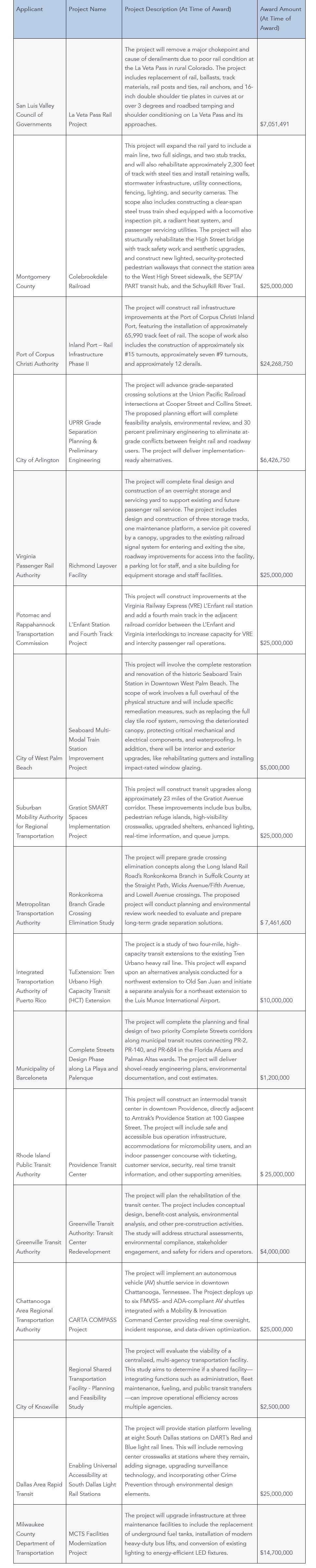
We’ve extracted the rail and transit recipients below. For a full list of 2026 BUILD recipients, click here.