


One of the original mass-marketing slogans in the 1950s in the U.S. was “Live Better Electrically,” an effort by General Electric and Westinghouse to get Americans to buy more electric things as part of the post-war boom.
Now, after 13 years of sometimes bitter fighting, it looks as if Amtrak and Canadian National have come to terms on a new eight-year operating agreement, part of which explicitly creates an official pathway out of the Superliner absurdity on the Illini/Saluki trains running on CN territory.
CN has long been concerned that shorter, lighter Amtrak trains might not reliably “shunt” track circuits — the electrical system railroads use to detect trains and activate signals and grade-crossing protection. The old operational workaround was essentially: if the single-level train might not reliably shunt the track circuit, make the train electrically “bigger” by adding axles/heavier equipment, or slow it way down and impose additional operating restrictions.
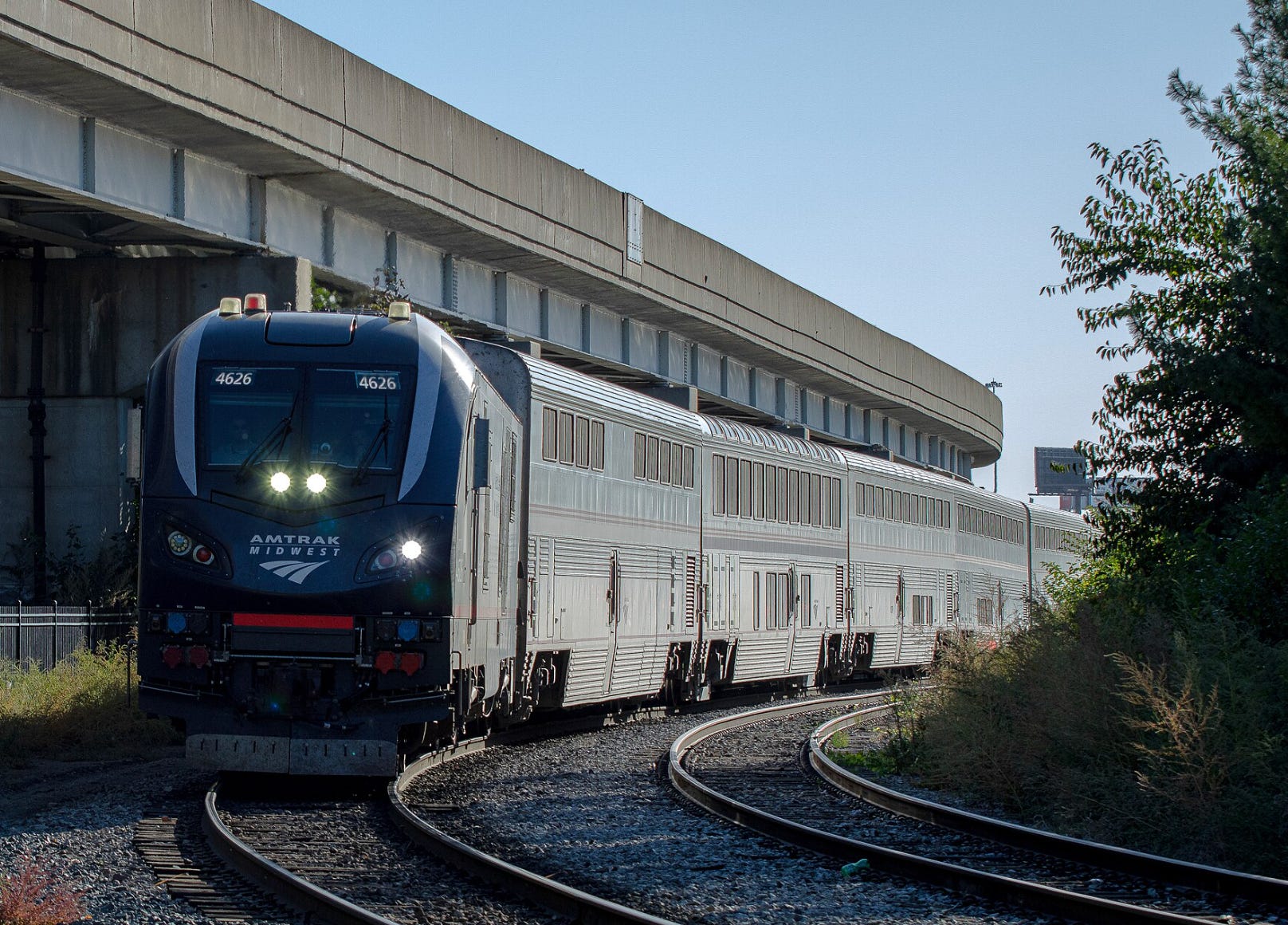
(Image credit: Guo Rui Pei / Chicago, Ill.)
So the answer was simple but, let’s face it, kind of dumb: bi-level Superliners running around Illinois doing work that perfectly ordinary single-level equipment ought to be doing…and not doing the work the long-distance network really needed them to do. Scarce Superliners wound up doing work in Illinois that absolutely did not require Superliners. A real safety problem, for sure, but a slightly absurd solution.
Now, finally, there is a better answer.
Under a new eight-year operating agreement announced this week, Amtrak and CN will work together to deploy onboard shunt-enhancement technology on Amtrak equipment operating over CN. Those devices are designed to improve the electrical connection between train and rail so that crossing and signal systems can reliably detect the train without requiring Amtrak to solve the problem by hauling around extra cars.
This isn’t just a laboratory experiment. In October 2024, Amtrak announced that it had received up to $58.8 million in Federal funding to buy and install onboard shunt-enhancement devices on hundreds of locomotives and cab cars nationwide, following years of testing with CN, the Federal Railroad Administration, state partners, and equipment suppliers.
In other words: there’s now a credible, funded technological path toward putting the right equipment on the right trains again.
What we don’t have yet is a timetable. Neither Amtrak nor CN has said when the new equipment will be fully fielded, when specific CN operating restrictions will be lifted, or when passengers will actually see the result in day-to-day service. So this is not a declaration that the Superliners disappear from Illinois tomorrow. But I think it’s something more important: a real pathway to making that possible.
That’s only one piece of a much larger settlement. The agreement also establishes new performance incentives tied more closely to Federal on-time-performance standards, provides for regular schedule reviews, and creates a process for resolving future operational disputes. Definitely something passengers can cheer about.
And, perhaps most importantly, it ends a proceeding that has been grinding along at the STB since 2013. Amtrak and CN both this week asked the STB to dismiss their proceeding, citing their settlement. Thirteen years of lawyers, filings, technical conferences, mediation, staff time and management attention, on both sides, before the parties finally reached an agreement that lets everyone move forward.
There will be more to say about all of this. The shunt problem itself raises some larger questions about how passenger rail uses scarce equipment, and why technical problems sometimes wind up being “solved” operationally for years instead of engineered out of existence. But those are stories for another day. For today, this is just good news and not a bad way to end our week.
I too am very pleased that CN and Amtrak have, if not settled, found a path forward from this 13 year kerfuffle.
But it must become unacceptable for the STB to preside over a “process” that provides full employment for lawyers and no resolution. That is simply regulatory malpractice.
So, how long and how many millions of legal team dollars will it take for Amtrak and Netro-Morth to work out their differences?